
Akron committee approves $2 million legal‑services ceiling, advances CityWorks modernization contract on consent
Get AI-powered insights, summaries, and transcripts
Sign Up Free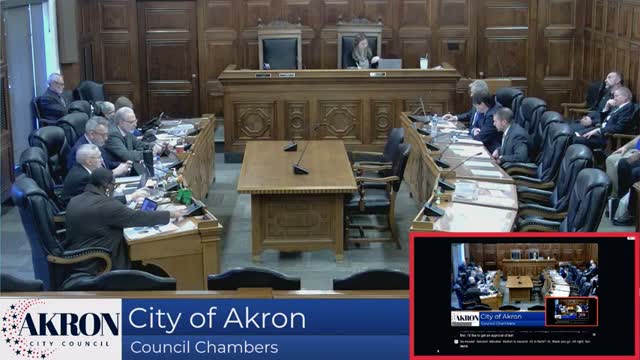
Summary
At a Jan. 15 Budget & Finance Committee meeting, council members approved on consent an ordinance setting a $2,000,000 ceiling for outside legal services and advanced a no‑bid contract with Wolpert Inc. to expand the CityWorks inspection and work‑order system.
Akron’s Budget & Finance Committee approved two consent ordinances Jan. 15, advancing a $2,000,000 ceiling for outside legal services and a contract with Wolpert Inc. to modernize the city’s inspection workflows through the CityWorks platform.
Deputy Director of Law Brian Angeloni told the committee the legal‑services ordinance is an annual authorization that covers attorneys and related experts used in litigation or regulatory matters. “This amount of money is kind of a…maximum,” Angeloni said, adding, “This is a ceiling.” He said the city has historically spent well below that cap; staff estimated last year’s encumbrances at about $738,000 and actual expenditures from this authorization at roughly $194,000.
Mike Wheeler, who introduced both items for the administration, said the Wolpert contract will expand a pilot that deployed tablets for housing inspectors and will integrate inspections and other workflows into the CityWorks system. Darren Ruzenic, chief technology manager, said CityWorks is GIS‑centric and can connect permit, parcel and owner data and also serve as the city’s 311 platform.
Councilwoman Linda Mobian asked whether expenses that exceeded the $2 million ceiling would come back to council for approval; Angeloni replied that any expenditure above $50,000 would return to council and that particularly large or specialized contracts are typically presented separately. The committee moved both ordinances to the consent agenda and recorded 'Aye' votes to advance them.
Staff said the Wolpert work is intended to consolidate departmental workflows, reduce duplicative systems and produce long‑term savings by standardizing inspections and work orders across housing and related programs.
The ordinances passed the committee on consent; city staff did not present an itemized list of specific vendors or task orders included under the legal‑services ceiling but said they would provide more detailed historical spending figures if council requested them.