
Finance Committee refers $20.7 million Portland Housing Bureau supplemental budget to City Council after debate over priorities
Get AI-powered insights, summaries, and transcripts
Sign Up Free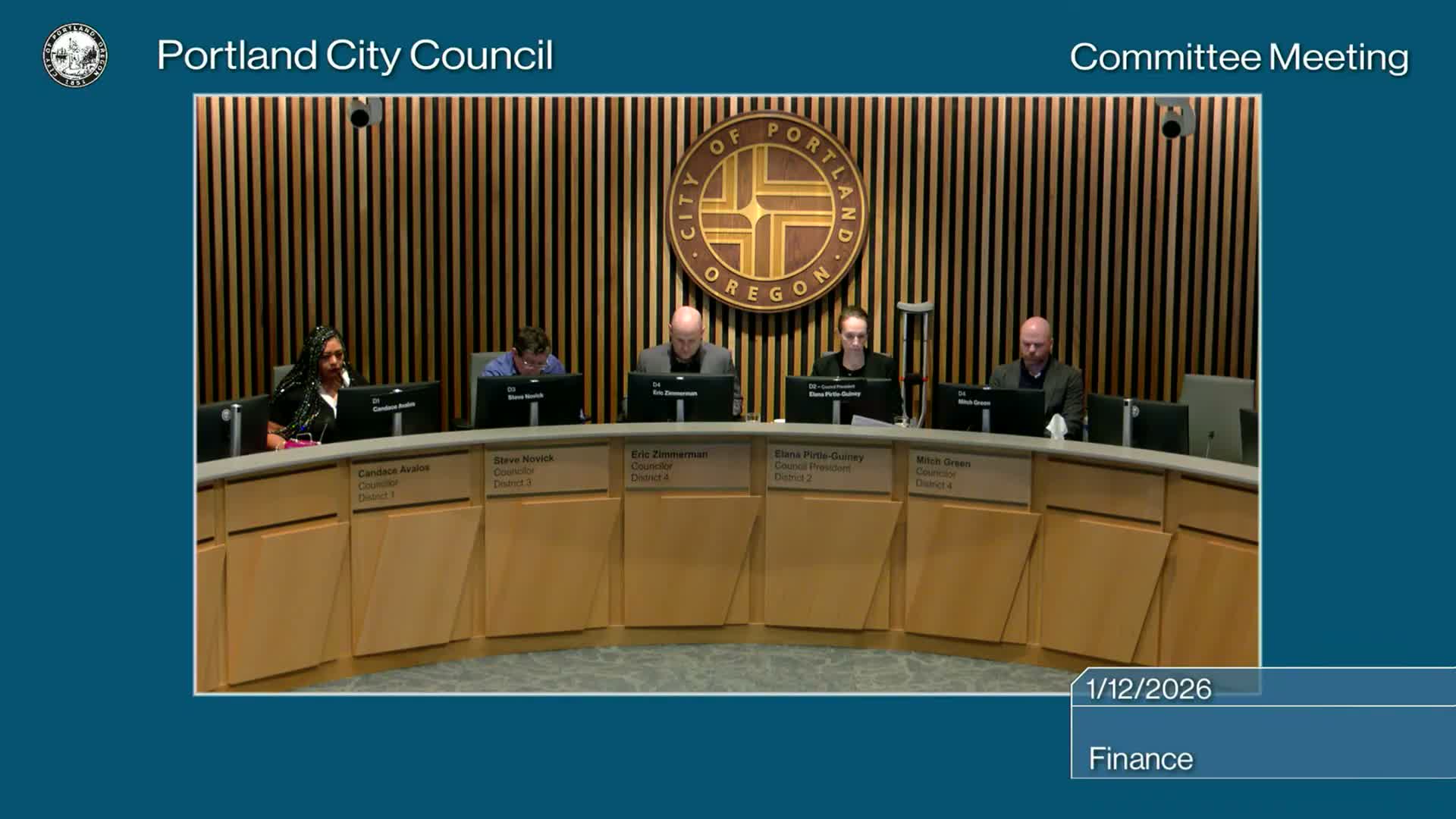
Summary
The Finance Committee voted 3-2 to refer a supplemental budget ordinance that reassigns roughly $20.7 million in unspent landlord-registry funds to a mix of development, down-payment assistance, rent stabilization and rapid rehousing programs after public testimony and an unsuccessful amendment to replace the ordinance's exhibits.
The Finance Committee on Jan. 12 voted to refer to the full City Council a supplemental budget ordinance that reallocates roughly $20.7 million in landlord-registry revenue to multiple housing programs, sending the measure forward by a 3-2 roll-call vote.
The ordinance, introduced by the sponsor, reallocates the unallocated registry funds across development and tenant assistance programs. The sponsor outlined allocations that include $1,000,000 in gap funding for the Williams and Russell project (about 85 affordable rental units and 25 ownership units), $1,500,000 in gap funding for Self Enhancement Inc.'s Northeast 13th Avenue permanently affordable homeownership project (about 18 units), a $5,000,000 increase for an RFP at 102nd and Burnside, $5,600,000 in gap funding for the Broadway Corridor via Prosper Portland (about 230 units), $1,000,000 for down payment assistance, $5,000,000 for rent and financial assistance to help people exiting shelter, $1,400,000 for affordable housing portfolio stabilization (rent buy-downs, debt restructuring and security/grants), $1,000,000 for a down-payment loan program administered by PHB, and a $3,700,000 return to the general fund by applying PHB administrative fee to the total (figures stated in committee remarks and exhibit descriptions).
Why it matters
The package attempts to balance short-term eviction prevention and rental stabilization with investments aimed at increasing homeownership and producing new units. Supporters from housing nonprofits and developers said the mix of gap funding and down-payment assistance helps projects and people simultaneously. Opponents — including several public commenters and Councilor Avalos — objected to the ordinance’s process and argued the substitute measure undercuts a previously developed “slow the inflow” resolution that prioritized immediate tenant-facing rent assistance.
Public testimony and exchanges
More than a dozen community speakers took public testimony. Amy Walsh of the Portland Metropolitan Association of Realtors said, “Homeownership is one of the strongest tools we have to stabilize households,” and urged support for down-payment assistance. Dana Fuller Shepherd, executive director of the Portland Housing Center, said PHC manages the city’s homeownership preference wait list and described the package as providing important but limited down-payment resources. Community advocates and service providers including NextUp and Welcome Home Coalition urged prioritizing rental assistance and eviction prevention; they said the substitute ordinance diverged from the product of earlier committee engagement.
Council debate and amendment
Councilor Green introduced an amendment that would replace the ordinance’s exhibits with language from an ordinance developed by Councilor Smith, tied to the slow-the-inflow resolution; Green argued the amendment would better preserve existing affordable housing and allocate gap funding to at-risk properties. Councilor Avalos strongly objected to the chair’s choice to advance a different ordinance rather than the version that had been developed through the housing and homelessness committee. The amendment failed on a roll-call vote (Avalos: Aye; Perugini: No; Novick: Nay; Green: Aye; Zimmerman: No). The clerk then called the roll to refer the ordinance to City Council; the motion carried (Novick: Aye; Green: No; Zimmerman: Aye; Avalos: No; Perugini: Yes/recorded as aye), and the committee recommended passage to full council.
What happens next
The ordinance is being sent to City Council for final action. The committee's discussion also included requests for additional budget-office and housing-bureau clarifications about eligible uses of restricted revenue and the mechanics of multiyear contingencies. The Finance Committee adjourned at 1:36 p.m.; the next meeting is scheduled for Jan. 27.
Sources and attribution
Quotes and substantive assertions in this story are drawn from testimony recorded in the Finance Committee hearing on Jan. 12, including statements by the ordinance sponsor, Councilors Avalos, Green, Novick and Perugini, and public testimony by Amy Walsh, Dana Fuller Shepherd and multiple housing advocates.