Get Full Government Meeting Transcripts, Videos, & Alerts Forever!
Get email alerts on the Assessment Scoring topic
No spam. Unsubscribe anytime.
Parent asks Niagara-Wheatfield board to review Grade 3 ELA scoring, requests vendor protocols and independent audit
Summary
A parent told the Niagara‑Wheatfield Board of Education that vendor-scored Grade 3 ELA constructed responses may have been scored inconsistently and asked the board for written vendor scoring protocols and an independent audit of a sample of responses.
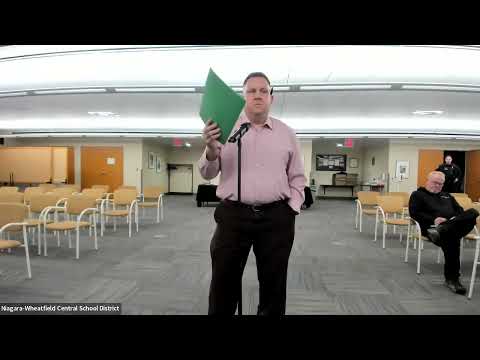
Jackson Tarr, a parent who gave his address as 2434 Fulton Street, urged the Board of Education of the NIAGARA‑WHEATFIELD CENTRAL SCHOOL DISTRICT to review potential inconsistencies in scoring on the 2025 New York State Grade 3 English language arts assessment.
“This statement respectfully requests the board's attention to potential scoring inconsistencies in the 2025 New York State grade 3 ELA assessment, specifically within constructive response items,” Tarr told the board and circulated two documents: the scoring rubric and a student response he said would score a full score alongside the rubric exemplar. He said the district does not score the test; scoring is done by a contracted vendor and “accuracy, consistency, and transparency are essential to protect students and to uphold assessment integrity.”
Tarr made two formal requests to the board: first, that the district require the contracted scoring vendor to provide written scoring protocols and quality-control documentation including interrater reliability statistics; and second, that the board commission “an independent audit of a statistically valid sample of these constructed response examples … scored blind by trained educators using the NICEF rubric” to compare results with the vendor’s scores. He said such steps would ensure students who need targeted interventions are identified accurately and prevent misidentification for services.
Unidentified Speaker 1 thanked Tarr for sharing his documents; there was no formal board response on whether the district will require additional vendor documentation or commission an audit during the meeting. Tarr’s statement and the materials he left with the board are now part of the record and available for the board’s review.
The board’s next regular meeting will determine whether to add follow-up action or direction to staff.