Get Full Government Meeting Transcripts, Videos, & Alerts Forever!
Get email alerts on the Housing Reserve Credits topic
No spam. Unsubscribe anytime.
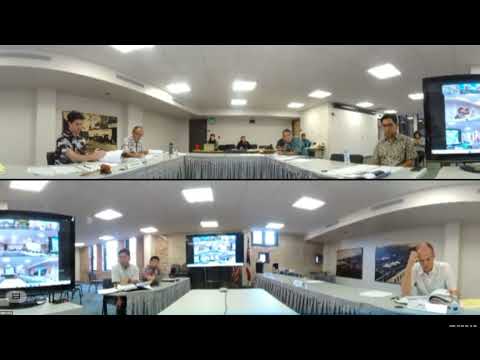
HCDA hearing: Gentry seeks to apply reserve‑housing credits to Ka'ulu and use HHFDC pilot funding
Summary
At a Dec. 3, 2025 Hawaiʻi Community Development Authority hearing, Gentry Kailua LLC asked to apply 57,243 sq ft of preexisting reserved‑housing credits (about 46 of 88 units) to its Ka'ulu project, keep 42 reserved units on‑site, and use a HHFDC pilot for four units. Public testimony was largely supportive; the record was closed and a decision hearing set for Jan. 7, 2026.
The Hawaiʻi Community Development Authority (HCDA) heard public testimony Dec. 3 on Gentry Kailua LLC’s request to amend its development permit for the Ka'ulu residential project in the Kailua Community Development District.
HCDA staff said the applicant proposes to apply 57,243 square feet of preexisting reserved‑housing floor‑area credits — generated by the Wakaia Garden Apartments project — toward Ka'ulu’s reserved‑housing obligation. Ryan Tam, HCDA director of planning and development, told the authority that the credits are equivalent to roughly 46 of the project’s originally required 88 reserved units and that after applying the credits Gentry would provide about 49,525 square feet (approximately 42 units) of reserved housing on‑site.
"The applicant is constructing a 390‑unit residential project on an approximately 29‑acre site," Tam said in summarizing the staff report. He added that the amendment would not change the project’s physical design but would alter how the reserved‑housing obligation is satisfied.
Andrew Kamikawa, vice president and chief financial officer of Gentry Homes and the applicant’s primary witness, said sales of reserved units have been slower than expected because mortgage interest rates remain elevated, competing inventory is available without occupancy restrictions, and costs have risen. "We are not changing any of the finishes," Kamikawa said when asked whether the converted units would become higher‑end product. He said the developer wants completed homes occupied by working Hawaiʻi residents rather than left vacant while awaiting market improvements.
Kamikawa also described a limited Hawaii Housing Finance and Development Corporation (HHFDC) dwelling‑unit revolving fund equity pilot allocation: "HHFDC approved $247,000 to be used on four units," he said, noting the pilot provides a 0% 30‑year second mortgage that can lower monthly payments but is limited to certain unit types.
Board members questioned Gentry on alternatives: why use credits rather than ask the authority to suspend reserved‑housing requirements, how public facilities dedication (PFD) calculations change if credits are applied, and what happens to the project schedule if credits are denied. Kamikawa said denying credit use could materially slow the project’s completion timeline and that Gentry would return to HCDA with documentation required to reflect the HHFDC program and any on‑site reserved‑housing configuration changes.
The record includes agency comments. Staff reported that the State Department of Transportation asked that prior DOT comments and easement conditions continue to be met; the Office of Hawaiian Affairs submitted concerns about use of credits. Kamikawa responded that the credits were generated within the same district and that the developer is not converting units into luxury product.
Public testimony was largely supportive. Rusty Rasmussen, senior vice president in charge of home loans at Central Pacific Bank, said higher rates and tighter mortgage qualification reduce the pool of buyers who both meet HCDA income limits and can obtain mortgages, leaving move‑in ready homes vacant. "The result is a completed move‑in ready home sitting vacant for years," Rasmussen said. Karen Polk, executive director of the Kapolei Chamber of Commerce, and Robert Jensen Garces, a West Oʻahu real‑estate broker, also urged approval, saying delays raise costs and reserved units face strong competition from unrestricted market product.
Counsel for the applicant asked that the hearing record be closed; the authority closed the record at the applicant’s request. No final decision was made at the public hearing. HCDA scheduled a decision‑making hearing for Wednesday, Jan. 7, 2026, at 9:00 a.m., to be held virtually and at the same physical location.
HCDA admitted exhibits 1–4 into the record and retained the project’s prior approval documents for reference. The board asked staff and the applicant to provide further detail on PFD calculation, the planned on‑site distribution of remaining reserved units, and the documentation needed to reflect HHFDC program participation when the matter returns for decision.
Next steps: the record is closed and the authority will consider a decision on Jan. 7, 2026. If HCDA approves the amendment it will need to confirm how public facilities dedication will be satisfied and how the reserved‑housing units will be documented on the final permit.