Get Full Government Meeting Transcripts, Videos, & Alerts Forever!
Get email alerts on the Candidate Interviews topic
No spam. Unsubscribe anytime.
Candidates for Lafayette council highlight wildfire readiness, housing trade-offs and community engagement
Summary
Four candidates interviewed at a special council meeting emphasized wildfire preparedness, trade-offs in rezoning for housing density, the need to modernize the land-use code, and local community-building. Interviews and public comments preceded the council’s later appointment decision.
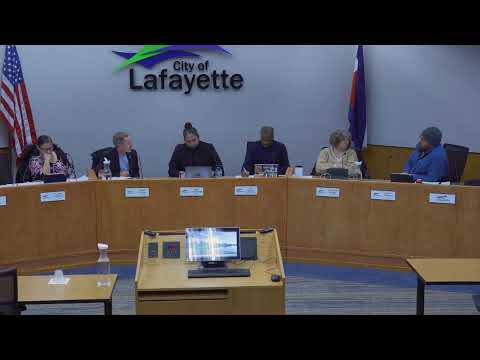
Candidates who applied to fill the Lafayette City Council vacancy used their 30-minute interviews to outline priorities and practical concerns facing the city.
Michael Watson (identified in the meeting as Mike) drew on military and medical experience to argue for grassroots engagement and cautioned against top-down planning that ignores conditions on the ground. He emphasized water supply limits in the face of prolonged drought, advocated for responsible infill rather than outward sprawl, and said small‑scale housing such as ADUs and modest multi‑unit projects in corridor areas could help (interview responses starting SEG 042).
Rob Glenn emphasized the council’s role as the community’s voice and highlighted his operations and small‑business experience. He stressed listening to city staff and residents, cautioned that construction costs can make new units unaffordable without grant support, and supported targeted density where infrastructure and transit can support it (interview responses from SEG 639). Glenn also proposed more on-the-ground community building to surface and address everyday maintenance issues.
Kyle Bollier framed wildfire and emergency preparedness as the city’s most pressing local risk after recent nearby fires. He recommended hardening infrastructure, improving evacuation alerts and incorporating resilience into land‑use and building codes. Bollier also supported targeted increases in housing density along major corridors to protect open space while calling for smarter transit investments (interview responses from SEG 1215).
Jeff Pistana emphasized preserving Lafayette’s open‑space character and expressed caution about high-density development, noting his concern that infrastructure can be strained if growth outpaces services. He identified traffic management and protection of the Coal Creek Open Space as priorities (interview responses from SEG 1966).
Throughout the interviews councilors focused questions on climate resilience, rezoning for higher density and transit policy. Candidates agreed that adding units is sensible when done affordably and in appropriate locations; all noted constraints such as construction costs, insurance/HOA complications and the need for state and grant support to make some projects feasible. Wildfire preparedness and emergency communication surfaced repeatedly as an area that requires immediate attention from the city.
The interviews were followed by a public‑comment period in which several Lafayette residents urged the council to appoint Kyle Bollier, citing his campaign outreach and knowledge gains. Councilors later weighed interview performance, public support and readiness to join council in their decision to appoint.
The interviews and public comments provide a record of locally prioritized policy areas for the incoming appointee and the council to address in the near term: wildfire response and alerts, land‑use code modernization for resilience and housing, and investments in transit and active‑transport networks.