
Custer County adopts sweeping zoning updates, including new STR limits and green-burial rules
Get AI-powered insights, summaries, and transcripts
Subscribe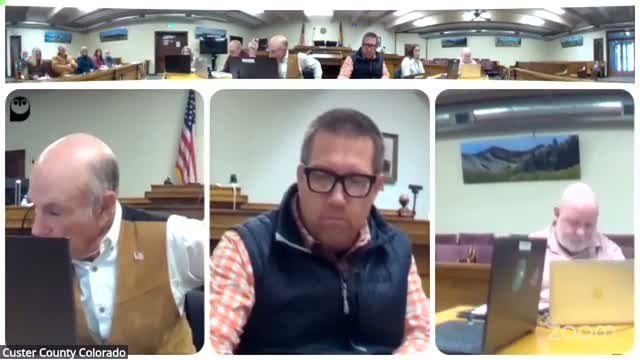
Summary
The Custer County Board of Commissioners adopted Resolution 25-50 on Nov. 12 to amend the county zoning resolution, changing definitions (including 'bedroom'), adding short-term rental application rules and density limits (with grandfathering), clarifying green-burial procedures, sanitation/OWTS language, and enforcement steps.
CUSTER COUNTY — The Custer County Board of Commissioners adopted Resolution 25-50 on Nov. 12, approving a package of changes to the county zoning resolution that update definitions, set new rules for short-term rentals and green burials, and clarify sanitation and enforcement procedures.
Chair Bill Canda opened the public hearing on the proposed amendments and told attendees, “we will be reviewing these regulations…we just will hear your questions.” Planning staff and the planning commission walked the board through a set of substantive edits — not simple punctuation or formatting changes — and recommended the board adopt the package.
Why it matters: The amendments change how the county defines key terms used across zoning enforcement and permitting (for example, staff proposed defining a bedroom as “any room intended for sleeping”), add new application requirements for short-term rentals (STRs) and special-use permits, and formalize administrative steps for enforcement and compliance. Together, the changes affect property owners, STR operators, developers and county permitting practice.
Key changes and debate
Definitions and formatting: Planning staff moved acronyms into the definitions section for clarity and proposed a simpler definition of “bedroom” as “any room intended for sleeping,” removing earlier square-foot minimums. Staff also added terms such as “breezeway” (a roofed outdoor passage between structures) and replaced some CRS references for consistency.
Quorum and planning commission language: The planning commission quorum language was adjusted (language changed from a quorum of 4 to 5) to reflect that the chairman now votes routinely; staff also replaced shorthand acronyms (PC) with the full phrase “County Planning Commission” in some places.
Sanitation and OWTS: The package clarifies sanitation rules and defines “Vault” as the Waste Holding Tank in Section 6.1. Staff removed some duplicative CRS references and added requirements tied to state OWTS (on-site wastewater treatment system) rules. Commissioners debated language that referenced the BOCC acting as the county board of health and ultimately removed redundant phrasing after discussion about how state regulations interact with county roles.
Short-term rentals: The amendments add several STR-focused provisions. Proposed application requirements include that applicants own the property for at least two years and provide written road-maintenance agreements where access is not publicly maintained. The package would require STR operators to include a dark-skies pamphlet and the county’s good-neighbor policy in posted house rules. On outdoor fire safety, the board discussed banning “outdoor flames” while allowing exceptions for UL‑approved gas or pellet grills and approved smokers; the board agreed to use language intended to prevent open campfires while permitting common, approved cooking devices.
STR density and grandfathering: Staff recommended a density limit barring new STRs within a half-mile of another STR except in historically tourism areas. Commissioners raised measurement questions (whether the half-mile is measured from structure or property line) and legal risks for retroactive restrictions. They agreed to add grandfathering language: “STRs whose initial approval was prior to 12/08/2025 shall not be subject to this restriction,” preserving existing approvals.
Green burial and recordkeeping: The revisions add detailed steps for private/green burials: obtain a disposition/private burial permit from the county clerk, verify GPS coordinates signed by coroner/sheriff/landowner, and record a private burial affidavit and death certificate with county offices within 30 days. Staff emphasized these requirements are recorded in county records and should appear in title work if filed.
Enforcement and cease-and-desist orders: The draft adds language to allow the county attorney and the director of planning and zoning (in their roles regarding compliance) to issue certified cease-and-desist orders; commissioners discussed whether the county’s current court-focused enforcement process should be retained or formalized in writing and sought to ensure any administrative order process would be legally robust and legally reviewed.
Final action and vote
After discussion, the board considered Custer County Resolution No. 25-50 — which states that the attached amendments are adopted and that the Office of Planning and Zoning shall republish the zoning resolution with the changes. A motion to adopt Resolution 25-50 was made and seconded. The chair called the vote; the record shows Commissioners Paul, Lucas and Chair Bill Canda voting “Aye.” The clerk recorded the adoption; the resolution states the effective date is the date of adoption.
What remains: Staff will republish the zoning resolution with the adopted amendments and prepare any accompanying map clause or recording documents the board traditionally signs at adoption. Several items noted by commissioners — for example, precise measurement language for the STR half‑mile and explicit grandfathering text — were clarified during discussion and will be reflected in the published final text.
The meeting adjourned at about 10:41 a.m.