Get Full Government Meeting Transcripts, Videos, & Alerts Forever!
Get email alerts on the Community Planning Guidelines topic
No spam. Unsubscribe anytime.
Council Member Tiffany Callan previews District 22 community planning guidelines, highlights housing and park priorities
Summary
Council Member Tiffany Callan and City Council planners previewed community planning guidelines for District 22 that prioritize deeply affordable housing, neighborhood planning, park access and small‑business supports; the full report will be released in the coming weeks.
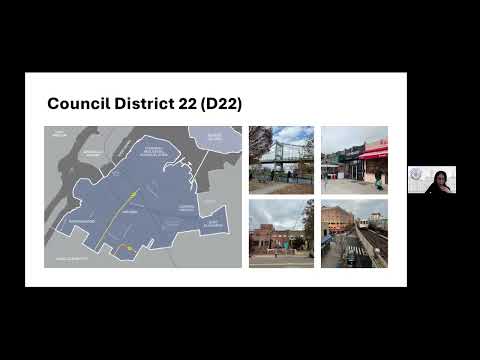
Council Member Tiffany Callan on Thursday previewed community planning guidelines for New York City’s Council District 22, saying the six‑month engagement process will guide land‑use decisions in the district and prioritize deeply affordable housing, improved parks and supports for small businesses. "It's been sort of difficult and frustrating to kind of deal with applications around development or housing on an ad‑hoc, lot‑by‑lot basis that really doesn't start with community," Callan said.
City Council land‑use staff summarized data gathered from focus groups, open houses and a survey of 782 respondents. Dana Leventhal, a borough planner in the Council’s planning and land use division, said the district has added more than 9,000 housing units since 2010 but only about 3% of those new units were deeply affordable (roughly fewer than 300 units at or below 50% of area median income). "Those trends really show how difficult it has become to find stable and affordable housing in the district," Leventhal said.
Planners presented three main levers to increase deeply affordable housing: expanding Mandatory Inclusionary Housing (MIH) using stronger options that target low AMI bands; prioritizing city‑owned parcels for 100% affordable developments; and expanding technical and financial support for nonprofit and mission‑driven developers, including community land trusts. Brian Paul, deputy director of the Planning and Land Use Division, said MIH can require 20–25% deeply affordable units under certain options but stressed MIH alone is insufficient.
Preservation was also a central theme. Staff recommended bringing more rent‑stabilized properties into HPD preservation programs, strengthening tenant legal services and using tools such as the Community Opportunity to Purchase Act to enable nonprofits and land trusts to acquire at‑risk buildings.
The guidelines propose more proactive neighborhood planning, particularly for areas with outdated or mismatched zoning such as Ravenswood and Old Astoria. "Neighborhood planning could give the community a chance to be more proactive in guiding growth and securing public investments instead of just reacting to private applications," Leventhal said.
On parks and the public realm, staff showed maps indicating large parts of the district lie more than a 10‑minute walk from existing parks and proposed advocating to the Parks Department to prioritize Community Board 1 for 'walk‑to‑park' acquisition approvals. Recommendations also included street‑safety projects coordinated with DOT, more street trees, sanitation resources from DSNY and expanded public‑art opportunities.
Callan said the report will be finalized and published in the coming weeks and that the guidelines will be used to evaluate future proposals and to pursue more comprehensive planning with the Department of City Planning. "We want to use this as our North Star when it comes to how our community grows," she said.
The presentation included a short Q&A. Staff and the council member responded to questions about why some rezoned lots near Socrates Sculpture Park have not yet developed, citing market and financing reasons, and discussed possible incentives and neighborhood‑level approaches to secure infrastructure and affordable housing. Staff also noted that building housing on top of smaller or under‑used city libraries has been done elsewhere but depends on site suitability.
Next steps: staff will finalize and publish the full report with detailed survey documentation, pursue neighborhood‑planning conversations with the Department of City Planning, and accept written feedback from residents via a follow‑up form.