
Weare board debates open‑enrollment plan, superintendent recommends 0% sending
Get AI-powered insights, summaries, and transcripts
Subscribe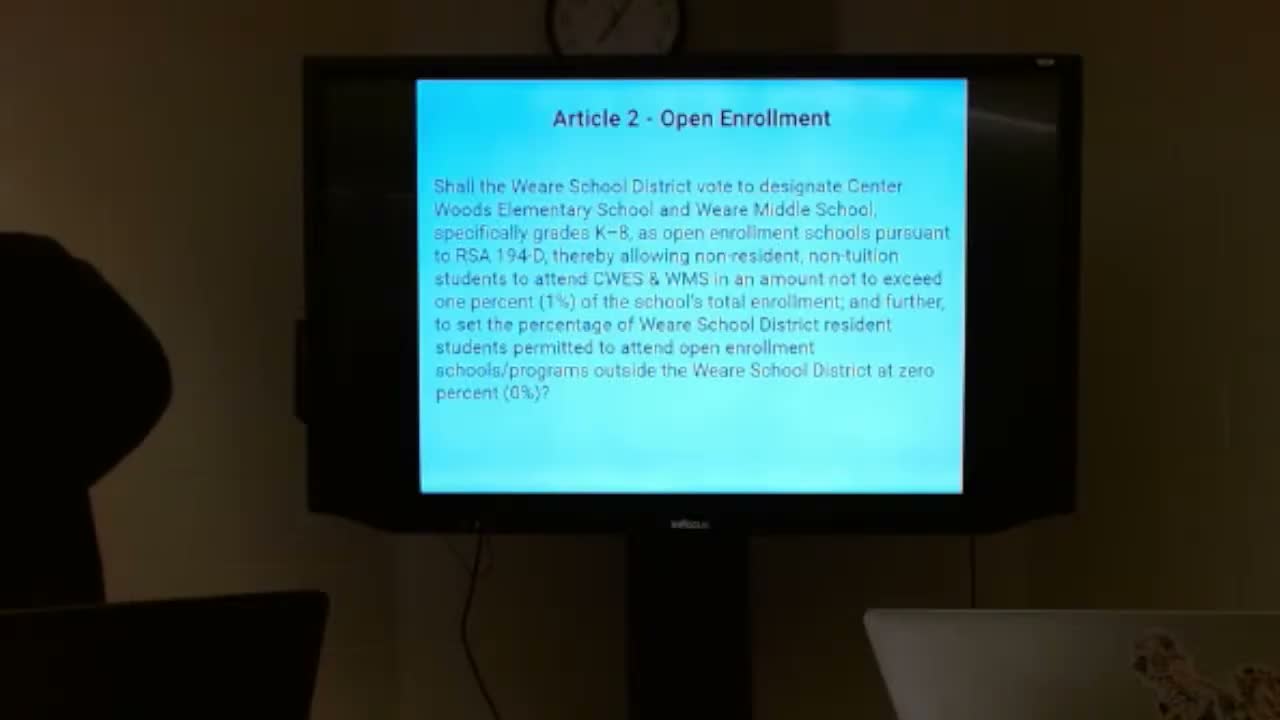
Summary
The Weare School District presented an open‑enrollment warrant article proposing up to 1% nonresident in‑students while recommending 0% sending to limit tuition exposure. Board members raised legal uncertainty, budget risk from tuition and special‑education costs, and the need to frame deliberative discussion around fiscal impacts.
The Weare School District moved into a detailed public hearing Jan. 14 to discuss a proposed open‑enrollment warrant article that would designate Center Woods Elementary and Ware Middle School as open‑enrollment schools and set district sending at 0%. Speaker 4, who introduced the article, said the recommendation is intended as a fiscal protection measure and not a commentary on parental choice: "I am recommending 0% sending."
The board read the warrant language aloud during the meeting. Speaker 4 framed the decision around the district’s cost per pupil, citing a Department of Education figure of $20,525 and explaining the tuition calculation: "That means our tuition rate that we would pay to other districts would be 16,420," Speaker 4 said, adding that 1% of enrollment (about eight students) would translate to roughly $131,000 in outgoing tuition. The presenter cautioned that larger percentages could substantially increase costs and special‑education obligations, noting a hypothetical 5% outflow (≈41 students) could cost an estimated $670,000 in tuition alone.
Board members pressed on practical and legal questions. They asked how seats would be allocated if demand exceeded the percentage limit, who would hold admission priority and how transportation responsibilities would be handled. Speaker 5 raised whether the school‑board association is lobbying the legislature about making tuition pegged to adequacy rather than 80% of local cost; Speaker 4 said the board has met legislators and that pegging to adequacy would reduce district liability but that the association’s lobbying status was unclear.
Speakers also warned of uncertain legal terrain. The superintendent’s presentation referenced court decisions and pending state bills that could change how open enrollment is applied and enforced: "We have seen things work through the court and the state board, and everything has been in favor of open enrollment," Speaker 4 said, urging caution about whether a local restriction would be upheld.
The board agreed to carry the article to deliberative session after clarifying language with legal counsel and to hold an additional public hearing on the article in mid‑February. How voters or a court ultimately resolve the district’s balance between protecting local budgets and preserving parental choice remained unresolved at the meeting.