Get Full Government Meeting Transcripts, Videos, & Alerts Forever!
Get email alerts on the Women Veterans Services topic
No spam. Unsubscribe anytime.
Women veterans tell Philadelphia commission services were cut at Women’s Veterans Multi-Service Center; seek quarterly meetings
Summary
Several women veterans testified that management changes at the Women’s Veterans Multi-Service Center have removed women-focused programs, donated clothing and social activities; they asked the Veterans Advisory Commission to press for transparency, quarterly meetings with management and restoration of services.
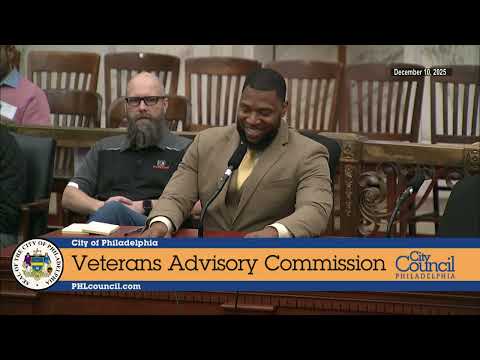
Rosalyn Jarvis, who says she founded the Women’s Veterans Multi-Service Center, told the Philadelphia Veterans Advisory Commission on Dec. 10 that a change in upper management over the last six months led to the removal of women-centered activities, donated clothing and toiletries and other supports that had made the center a ‘‘safe place to breathe again.’'
Jarvis recounted that activities such as group meals, game nights, birthday celebrations and other social supports were cut without explanation, and that donated clothing and toiletries that veterans used for job interviews and daily needs were taken away. ‘‘These donations were dignity. They were hope,’’ Jarvis said, adding that renovations — a kitchen, washer and dryer and a shower — make the cuts harder to understand.
Bessie Richardson Bay, a former center participant who said the facility helped her exit homelessness and addiction, described the loss of a communal gathering area that was converted into a daycare and the removal of computers used for housing and benefits work. She told the commission that women veterans were frequently excluded from decisions affecting their space. ‘‘We are asking that we are included in changes that are being made on our behalf,’’ Richardson Bay said.
Jarvis proposed quarterly meetings that include women veterans, on-site staff and upper management so users of the center can participate in decisions affecting services. Commissioners and the director pledged to follow up: an Unidentified Speaker on the commission thanked Jarvis for ‘‘powerful testimony’’ and said the commission and the director ‘‘will look into this’’ and set up a meeting to address the issue.
The testimony raised several concrete requests for the commission: restore donated clothing and toiletries for women in need, reinstate social and supportive programming for women-only spaces, and create a formal advisory or regular consultation mechanism so frontline staff and veteran users are included when management alters services. Jarvis and other speakers said case managers on-site remain committed to veterans and that their removal from decision-making, not frontline staff, drove much of the problem.
The commission did not adopt formal action during the meeting. Commissioners said they would arrange follow-up meetings to review the center’s staffing and management decisions and to consider the quarterly-roundtable proposal. The commission’s director, Gregory Wright, was present and the office said it would coordinate next steps and additional outreach to affected women veterans.
The commission asked Jarvis and other speakers to share surveys and documentation they had submitted so staff could include those records in a follow-up discussion.