Get Full Government Meeting Transcripts, Videos, & Alerts Forever!
Get email alerts on the Digital Government topic
No spam. Unsubscribe anytime.
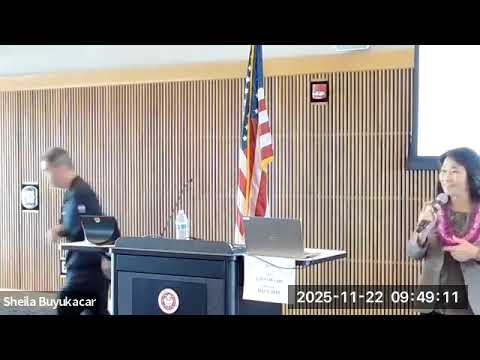
Lt. Gov. Sylvia Luke highlights digitization wins, urges students to help modernize state systems
Summary
At the 10th annual Hawaii Code Challenge, Lieutenant Governor Sylvia Luke told students their projects can change government operations, citing a digitized agricultural 'egg' form and a modernization that reduced a year-long incarceration caused by paper records.
Lieutenant Governor Sylvia Luke told participants at the tenth annual Hawaii Code Challenge that student developers can produce technology that changes people’s lives and helps modernize state government.
"What these folks do are impacting individuals' freedom or individuals' lives," Luke said as she recounted a case in which outdated paper records contributed to an incarcerated person staying about a year longer than intended. She described work to modernize that system and to replace a paper agricultural arrival form with a digital alternative, which she said improved compliance and tracking.
Luke said the state’s digital form—referred to in her remarks as an "egg form"—and a new arrival app made it easier for both travelers and Department of Agriculture staff to log and inspect incoming items. "For the customer experience, it's so much better," she said, and added that compliance rates have risen from about 40–50% to roughly 80% after digitization.
Why it matters: Luke framed the examples as proof that small software projects can have outsized public impact—shortening case-processing errors that affect individual liberty and improving biosecurity and regulatory compliance at ports of entry. She urged students to view the Code Challenge as a pathway into public-sector work and to consider how AI and cloud tools could be used to solve state problems.
State and private partners on stage—including University of Hawai‘i staff and corporate sponsors—stressed workforce and AI opportunities. Organizers said 98 participants signed up this year, 32 teams entered the technical rounds and 19 teams presented before judges.
What happened next: Luke invited judges and sponsors to engage with students about commercial or public-sector testing opportunities. Organizers moved the program into timed team presentations judged on technical implementation, functionality, innovation, user experience and security/privacy.
The event continues with team demos and judging rounds; prizes include cash awards and sponsor-run beta-testing opportunities for selected projects.