Get Full Government Meeting Transcripts, Videos, & Alerts Forever!
Get email alerts on the NAGPRA Compliance topic
No spam. Unsubscribe anytime.
SIU outlines progress on NAGPRA compliance; confirms federal control for some collections
Summary
SIU’s NAGPRA lead briefed trustees on obligations under the Native American Graves Protection and Repatriation Act, noting updated regulations effective Jan. 2024, inventories of NAGPRA‑eligible holdings, and confirmation that federal agencies have control of some collections — including 31 Native American individuals previously reported as under SIU control.
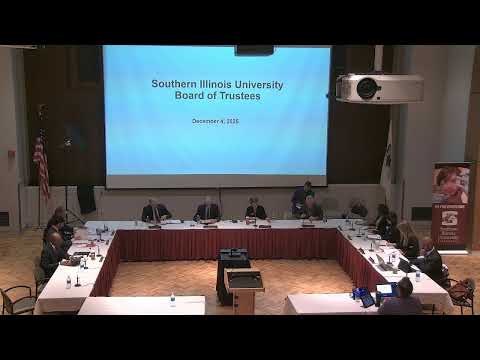
Carol Samara, leading SIU’s NAGPRA work, told the board on Dec. 4 that the university is accelerating compliance with the Native American Graves Protection and Repatriation Act (NAGPRA), emphasizing legal duties and government‑to‑government consultation with federally recognized tribes.
Samara explained NAGPRA’s legal foundation — codified in Title 25 of the U.S. Code — and said updated NAGPRA regulations that took effect in January 2024 strengthen consultation requirements and recognize tribes as experts in traditional knowledge. She told trustees that SIU has been inventorying NAGPRA‑eligible holdings across its collecting units (the Sharp Museum at Carbondale, the University Museum at Edwardsville, the Pearson Museum at the School of Medicine) and that the Center for Archaeological Investigations (CAI) holds the largest set of NAGPRA obligations.
Samara said SIU timely notified federal agencies this year and that, working with those agencies, the university confirmed federal control over numerous collections previously reported to SIU — including 31 Native American individuals that had earlier been listed as under SIU control. Those now‑federal holdings shift responsibility for the NAGPRA process to the relevant agencies, she said, and SIU is actively reaching out to tribes to build relationships and proceed with consultation and repatriation where appropriate.
Trustees asked clarifying questions about the relationship between land acknowledgements and NAGPRA obligations; Samara said land acknowledgements are a separate practice and do not substitute for federal NAGPRA duties to consult on human remains and cultural items. She characterized NAGPRA compliance as an opportunity for the university to strengthen trust and build meaningful relationships with tribes.
Trustees and the administration commended Samara and staff for progress and asked for continued updates as inventories and consultations proceed.