Pitkin County staff flags water, floor‑area caps and TDR updates as top code priorities
Summary
Staff told the Planning & Zoning Commission that high‑priority code updates tied to the Vision 2050 draft include water‑adequacy and groundwater standards, square‑footage and floor‑area tiering, and changes to the transferable development‑rights program; those items will be advanced once the plan is referred and adopted.
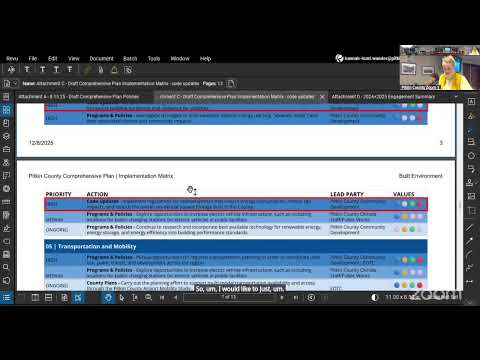
Planning staff used the implementation matrix to identify near‑term code updates that will accompany the comprehensive plan. The highest‑priority code items are concentrated in two areas: water and the built environment.
Water-code priorities listed as high in the matrix include updated water‑adequacy requirements for new development and redevelopment, well‑pump testing and metering, standards to regulate ponds, permitting protocols for hauled water, and water‑wise landscaping and outdoor water‑efficiency standards. Staff said a water‑land‑use consultant is on the team to align code changes and policy direction.
In the built environment, staff highlighted the floor‑area allocation system for residential development above 5,750 sq ft, square‑footage tiering with net‑zero performance targets, updates to the growth‑management scoring system, and targeted modifications to the county’s TDR program. Staff said some items are already underway (for example, prior building‑code tiering) while other items will be carried forward into the 2026 code‑update work plan.
Staff also flagged the Colorado Wildfire Resiliency Code as an upcoming site‑constraint item and called for additional work on scenic‑quality code (dark‑sky lighting standards and view protections). Commissioners asked staff to make sure definitions and character maps (remote, rural, semi‑rural) are clear so that implementation measures are applied consistently.
Staff said the implementation matrix will be published as a living document to guide prioritized work and help coordinate county and partner agency efforts.
AI generated
The text on this page is AI generated. Summaries, highlights, analysis, and video transcripts are all produced from the original source material.
AI can make mistakes, so if you spot one, and we will fix it for everyone.
Note: the source content is unaltered by us. Any content source we link to, be it a video, an audio recording, or a document, is presented exactly as its publisher released it. That publisher is usually a government body, sometimes an individual official or another organisation.