Get Full Government Meeting Transcripts, Videos, & Alerts Forever!
Get email alerts on the Fiscal Report topic
No spam. Unsubscribe anytime.
Finance director and PICA warn progress but urge caution as committee reviews city's fund balance
Summary
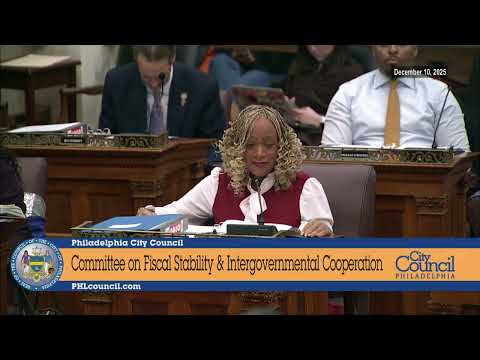
At a hearing on resolution 240,886 the city's finance director reported an unaudited FY25 fund balance of about $1.2 billion and projected FY26 balance near $640 million, while PICA urged more reserves and careful budgeting for new initiatives amid pension and federal funding risks.
City officials and the Pennsylvania Intergovernmental Cooperation Authority (PICA) told the Committee on Fiscal Stability that Philadelphia's fiscal position shows progress but faces non‑trivial risks.
Rob Dubow, the city's Finance Director, testified the unaudited FY25 general fund balance was "approximately $1,200,000,000," driven in part by unfilled positions and a lapsed federal reserve, but he warned those drivers are not fully recurring. Dubow said the projected FY26 fund balance falls to about $640,000,000 once those nonrecurring items and the end of American Rescue Plan Act cushions are considered.
Dubow told the committee the city has worked to fill many vacancies (he said more than 1,600 general‑fund positions were filled since the start of the Parker administration) but that vacancy allowances and volatile tax streams (for example business income receipts and real estate transfer taxes) complicate forward revenue assumptions. He said the city plans to request reconstitution of a federal funds reserve the administration expects to seek in the FY26 budget process.
During questioning, council members pressed officials on whether vacancy savings (roughly $160 million cited from FY25) could be redirected to raise city worker pay or otherwise mitigate immediate hardship for low‑paid municipal employees. The administration said salary increases and contract commitments have been factored into the fiscal plan and that much of the vacancy savings will decline as positions are filled.
Marissa Waxman, executive director of PICA, praised recent fiscal improvements — "Philadelphia's fiscal trajectory has been good, improved bond ratings, more reserves, and progress towards a fully funded pension system" — but urged caution: PICA recommended stronger contingency reserves, improved budget scoping for new initiatives, and sustained commitments to pensions and labor costs. Waxman noted that the FY26‑30 plan has limited built‑in contingency against future federal funding reductions and encouraged the city to maintain long‑term fiscal discipline.
The committee asked for more accessible explanations for residents about how fiscal choices affect everyday services. PICA offered to provide explainer materials and highlighted that comparisons to peer cities require careful selection of metrics because Philadelphia's status as a consolidated city‑county alters revenue streams and responsibilities.
Next steps: the committee will use the testimony in upcoming budget deliberations and asked administration staff to continue producing disaggregated data on vacancies, the demographic profile of workers under AMI thresholds, and second‑quarter fund balance projections before finalizing FY26 adjustments.