Get Full Government Meeting Transcripts, Videos, & Alerts Forever!
Get email alerts on the Home Plan topic
No spam. Unsubscribe anytime.
Council committee backs amended HOME bond ordinance after hours of testimony
Summary
The Committee on Fiscal Stability reported bill 251065 with a favorable recommendation after testimony from the Parker administration, council members and dozens of residents about who should qualify for HOME repair programs. The vote follows competing proposals over AMI eligibility and a request from the administration to limit council's authority on income caps.
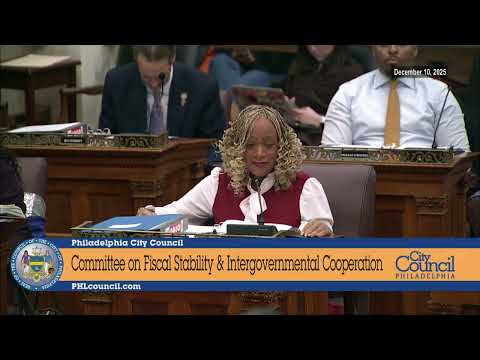
Council's Committee on Fiscal Stability and Intergovernmental Cooperation on Wednesday reported bill 251065 — an amendment to the HOME bond ordinance — with a favorable recommendation after several hours of testimony and public comment.
The bill would authorize the Philadelphia Redevelopment Authority to issue bonds and approve a service agreement to finance the Housing Opportunities Made Easy (HOME) plan. The plan is part of what council members and administration witnesses described as an $800 million multi‑year investment to build, restore and preserve housing across the city; the administration expects to issue the first $400 million in bonds once the ordinance and corresponding budget resolution are aligned.
Jamie Gauthier, a councilmember and housing committee member, opened debate by saying, "There's a lot of misinformation being spread about city council's amendments to HOME," and he defended council's change to reserve the bulk of first‑year repair funds for households at or below 60% of area median income (AMI) while allowing limited access for higher earners. Gauthier and other supporters said the amendment preserves capacity for the most vulnerable while expanding access to middle‑income homeowners who frequently face unaffordable repair costs.
The Parker administration, represented by Tiffany Thurman, chief of staff to Mayor Sherrell Parker, told the committee it supports many technical updates that align the ordinance language with the annual program statement but objected to a sentence in section 2(b)(1) that would give council broad authority to set AMI qualifications. Thurman said, "If this sentence is not amended, then we cannot and will not support this ordinance in its entirety," and proposed limiting council's authority so it could set AMI qualifications for no more than 60% of the funding in any program or subprogram.
Thurman and administration materials also presented numbers to illustrate possible impacts of different AMI caps. The administration said the HOME package totals roughly $800 million, the first annual program statement outlines about $277 million in year‑one spending, and the city had designated roughly $50 million for the two repair programs at issue — Basic Systems Repair Program (BSRP) and Adaptive Modification — in year one. Thurman warned that effectively capping eligibility at 60% AMI could disqualify thousands of city employee households and other working Philadelphians from those repair programs.
Council members and community speakers offered competing emphases. Councilmember Curtis Jones and several public commenters — including senior homeowners and tenants' advocates — stressed that many residents who appear to be "middle class" on paper nevertheless cannot absorb major repair costs and that delays can produce immediate health and safety harms. Others, including council members Rolando and Gilmore Richardson and neighborhood leaders, argued the amendment expands overall funding and would not displace people already waiting for services.
Dozens of witnesses from tenant groups, community development corporations, contractors and faith organizations spoke during the public comment period. Melissa Montz, a tenant advocate, urged the committee to "stand by your vote" and highlighted newly allocated funds for low‑income renters and a right‑to‑relocation fund. Will Gonzales of Saba and other local leaders sought language access and full participation by community development corporations to ensure neighborhood delivery.
The committee moved to a public meeting and Majority Leader Catherine Gilmore Richardson moved that bill 251065 be reported from the committee with a favorable recommendation; the motion was seconded and the chair announced, "The ayes have it." The transcript records the committee's action but does not list a roll‑call tally of individual yes and no votes in the minutes.
Next steps: the ordinance will be placed on the council calendar for final passage alongside the matching annual program statement and budget resolution, which the administration asked be held to move simultaneously so the language between the two measures remains consistent.