Get Full Government Meeting Transcripts, Videos, & Alerts Forever!
Get email alerts on the Offender Residency Exemption topic
No spam. Unsubscribe anytime.
Jackson board hears petition for residency exemption; discussion ends without recorded vote
Summary
The Village of Jackson considered an exemption request to its offender-residency ordinance from Jermaine Carson. Police opposed the petition citing untruthfulness and ordinance violations; supporters cited rehabilitation. The transcript shows deliberation and a motion to deny but no recorded vote on the petition before adjournment.
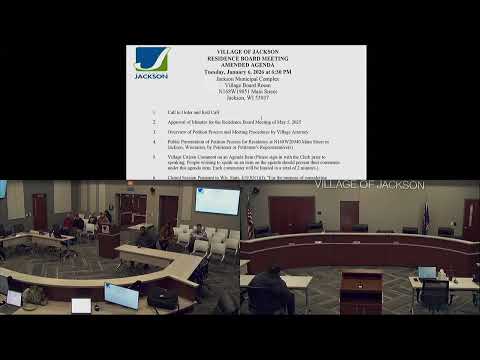
The Village of Jackson board on the evening of the recorded meeting heard presentations and public comment on a petition from Jermaine Carson seeking an exemption to the village's offender-residency ordinance, which establishes a 1,500-foot setback from schools, parks, day-care facilities and other child-centered locations.
Village attorney Matt Parmanchier reviewed the ordinance and the board's worksheet procedure for exemptions, telling the board members they would evaluate criteria including the nature and date of the offense, treatment history, remorse, time since incarceration and proposed safety assurances. He said the application packet included the landlord's letter, the application, and investigative materials from the police department.
A police department representative summarized the department's position to the board and recommended denying the petition. The representative said Carson was convicted of first-degree sexual assault of a child, that the victim was under 12 at the time, and that the department's file showed the applicant had been untruthful in interviews and had later been cited for violating the residency restriction. The representative added the department had received reports that someone at the Main Street residence had offered babysitting services, and stated, "We remain objecting to his petition to reside at this address."
Carson addressed the board and described the offense as having occurred when he was a minor nearly 20 years ago. He said he is 34, works and is trying to keep a steady job and home with his fiance9e. Parmanchier read a character and employment letter from Ashley Bonnier, store manager at Blaine's Farm and Fleet of Grafton, saying Carson had worked there for about two years and was "an asset to our store".
Two residents spoke at public comment. Joseph McElfresh, who said he lives across the street from the Main Street address, urged denial and said he had seen Carson leaving the residence, called the situation a "serious public and safety concern" and noted children live nearby. Morgan Zimmerman, who identified the Main Street address as her own, urged approval and said Carson had not reoffended, had an alcohol problem in the past but was improving, had been released in October 2024, and recently had an interlock device removed.
After public comment the board went into closed session for legal and personnel discussion and then reconvened to work through the worksheet criteria on the record. The board confirmed the offense listed in the application as first-degree sexual assault dated 11/21/2007 and heard that the police report lists the victim's age at the time as six. Members discussed the lack of a treating-practitioner recommendation, AODA completed in 2022, the applicant's support network, the police's investigative findings including the new citation for residency violation, and the babysitting allegation.
Board members expressed differing views about remorse and rehabilitation. One member said that the applicant's denials to police and the need to reinterview the victim did not demonstrate remorse and that the residency violation and babysitting reports undermined confidence in safety. Another member acknowledged signs of remorse and the employer letter but said they would like to see additional counseling or AA participation before granting an exemption. Several members said they gave weight to the police recommendation and the ordinance's protective purpose.
A board member stated a motion to deny the petition; the transcript then records a separate motion to adjourn, a second, and ayes, and the meeting was adjourned. The transcript does not include a recorded second or a roll-call or voice vote resolving the motion to deny. Because no formal vote on the petition appears in the provided transcript, this report does not assert a final board decision on the exemption.
The board discussed possible conditional approvals earlier in the process but did not announce any conditions or an approval in the transcript. Next procedural steps, if any, were not recorded before adjournment.