Get Full Government Meeting Transcripts, Videos, & Alerts Forever!
Get email alerts on the Finance topic
No spam. Unsubscribe anytime.
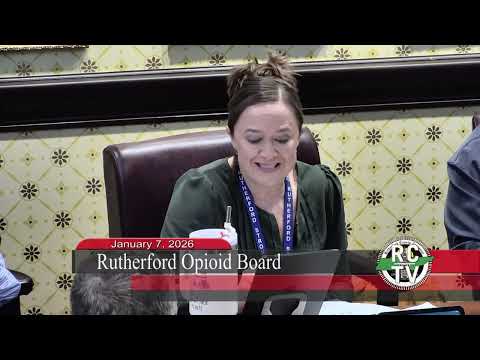
Rutherford County opioid board flags sharp drop in 2026 allocation, adopts priority rule for grantees
Summary
Board staff reported a projected 2026 allocation of $789,823.92 from the Tennessee Opioid Council, a significant reduction from recent years; the board voted to give priority to applicants who have not received funding for three consecutive years and affirmed a $100,000 grant cap as they finalize the RFP and application timeline.
Chairman Harris and staff warned of a substantial downturn in opioid trust funds for Rutherford County in 2026, and the board moved to adjust funding priorities accordingly.
Alyssa, presenting the county financial report for December, told the board the Tennessee Opioid Council’s payment for 2026 to Rutherford County is $789,823.92. She contrasted that figure with prior years and noted that restricted and unrestricted balances have declined: "So that's the amount that has been allocated to Rutherford County," she said, adding the figure could fluctuate with settlement developments.
Board members said the drop will force adjustments to allocation strategy. "That's a tremendous amount of money. And it's getting and it's shrinking," Chairman Harris said, noting the board must re-evaluate how to allocate limited funds.
Staff also presented a draft request for proposals (RFP) that incorporated an already approved $100,000 per-award cap and a single application period. The RFP draft asked applicants to describe sustainability plans and assigned a modest number of points to sustainability to help the board weigh multiyear viability.
After debate about how to balance support for established programs and opportunities for new applicants, the board approved a motion directing that funding priority be given to agencies that have not received grants for three consecutive years. Trish moved the motion; a member seconded it, and a roll call found all present voting yes. The motion’s language says priority will be given to agencies not funded for three consecutive years to "reduce agency reliance on Rob for ongoing multiyear support." The board also discussed — and agreed to verify with county counsel — whether for-profit treatment providers might be eligible under county grant rules, noting prior guidance usually limited awards to nonprofits and government entities.
Staff emphasized timelines: a press release and two application workshops are planned, applications would close March 31, review would occur in April–May, and the board would consider funding recommendations in May and June with a July 1 start date for awards.
The board’s next steps are finalizing the RFP language (including the sustainability rubric and priority wording), confirming legal constraints on eligibility with county counsel, and preparing outreach and application materials for the new cycle.