
Budget season begins: Averill Park highlights maintenance shortfalls, rising energy costs and transportation pressures
Get AI-powered insights, summaries, and transcripts
Subscribe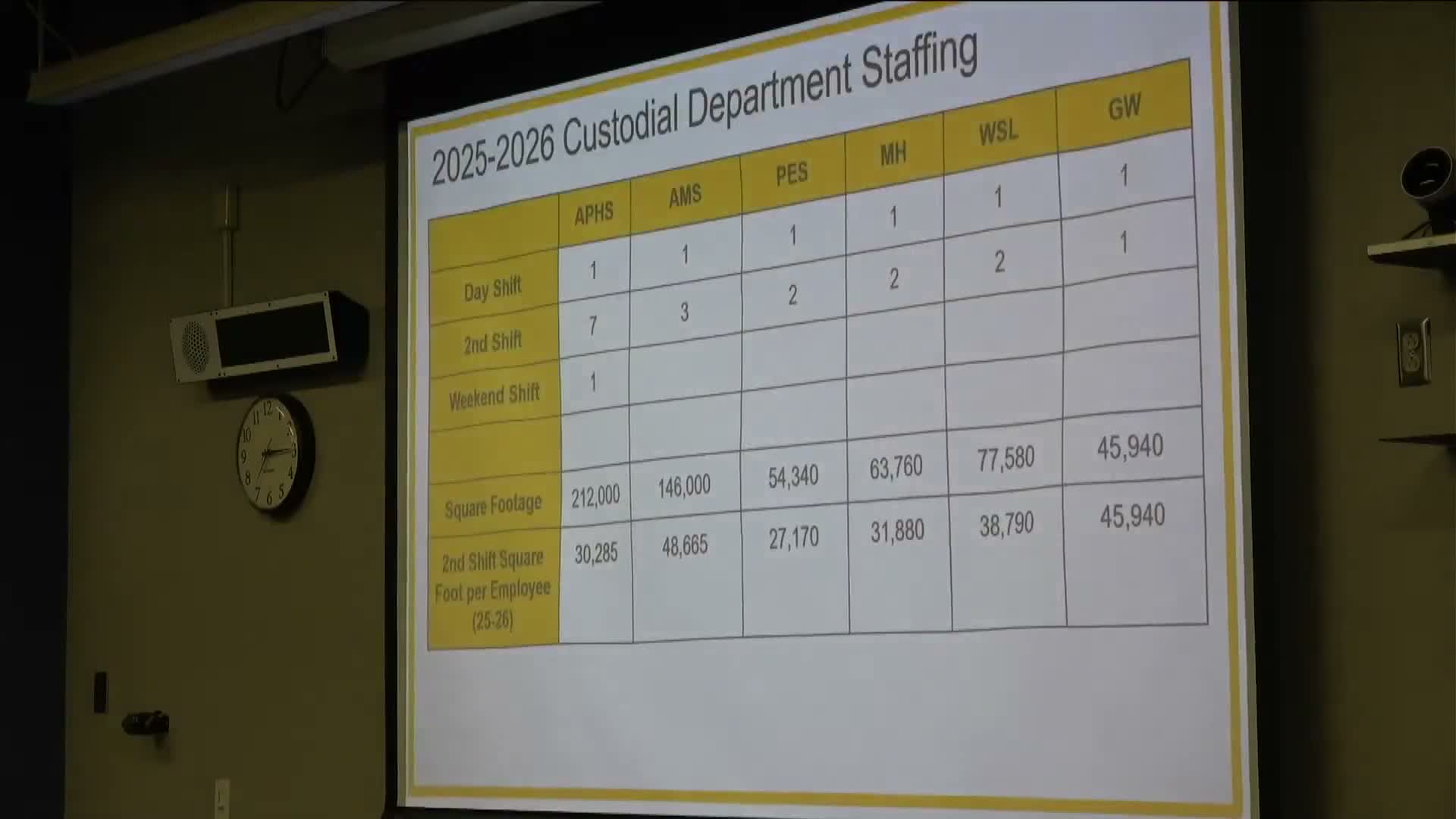
Summary
At the Jan. 12 board meeting the district presented non-instructional budget priorities: understaffed maintenance and grounds, sharp projected delivery-rate increases from utilities, a proposed $100,000 recurring capital outlay cycle, and transportation challenges including driver shortages and an aging bus-wash system.
Carrie, the district’s operations presenter, opened the non-instructional portion of the 2026–27 budget discussion on Jan. 12 by laying out staffing and operating pressures across facilities and transportation.
On custodial and maintenance staffing, Carrie said second-shift custodial coverage leaves some buildings with high square-foot-per-custodian loads (Algonquin singled out as particularly high) and reported the maintenance team is effectively five people while the recommended ratio implies the need for an additional maintenance staffer. "Our current staffing is at 5 people," she said, noting that directors sometimes perform manual tasks now handled by maintenance staff.
Carrie detailed grounds staffing and equipment: three grounds employees cover roughly 70 acres and 11 fields, and the district plans incremental equipment replacements (a zero-turn mower this year; the bobcat loader is a larger-ticket future item). She recommended prioritizing maintenance staffing and targeted equipment purchases to improve efficiency.
Energy costs were described as an immediate budget pressure. Carrie said National Grid approved a three-year delivery increase of about 31% for electric and 40% for gas while NYSEG has requested increases in a similar range. The district participates in NYSMAC, a purchasing consortium for electricity, with a new supply bid beginning May 2026, but rising delivery fees are forecast to push operations expenses higher.
Transportation was a major focus. Carrie reported an ongoing driver shortage that has resulted in longer routes and higher student loads. The district’s bus-wash system is roughly 30 years old and requires inspection and likely staged repairs. To mitigate operational and safety risks, she proposed investing in a GPS/attendance system integrated with Transfinder to provide live bus locations, a parent tracking app, swipe-on student attendance, and improved routing for substitutes. "It's about a $100,000 ticket just to install it," Carrie said, and estimated ongoing annual costs of roughly $40,000. She also said transportation aid (historically about 70%) can be sought from the State Education Department to offset initial and ongoing costs.
Board members asked practical questions about whether parents could use personal phone GPS apps, the process for driver onboarding and routing constraints (some roads are intentionally avoided for safety), and whether swipe-on systems would slow routes. Administration responded that the Transfinder integration allows preloaded routes and that morning boarding could be quick with proper hardware and training.
Carrie closed with the capital outlay proposal: the district expects to continue the $100,000 capital-outlay cycle, which is reimbursed the following year and is a way to tackle small-to-midsize projects without larger borrowing. The administration also flagged a forthcoming facilities committee meeting to refine one proposed capital outlay project for 2026–27.
The board thanked the presenters and acknowledged the operational pressures; no budget adoption occurred on Jan. 12, but the session set priorities for the coming months and identified several items that will move to committee review and further planning.