
Twinsburg leaders present tax-budget numbers and weigh proposed school-district earned-income tax for May ballot
Get AI-powered insights, summaries, and transcripts
Subscribe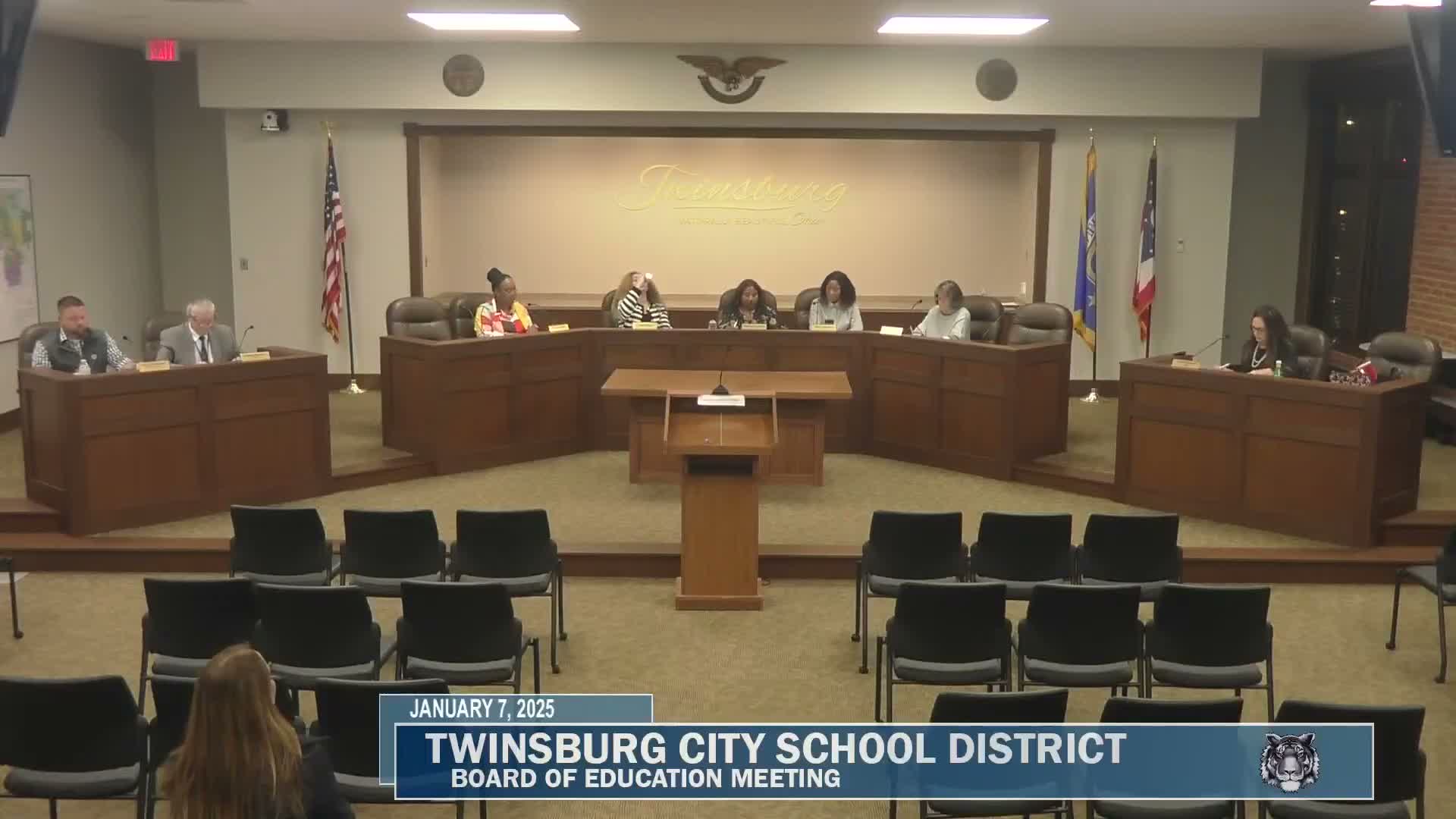
Summary
At a public tax-budget hearing Jan. 7, Twinsburg treasurer Julia Rosnaya and Superintendent Marlowe outlined a fiscal forecast that includes a projected FY2028 deficit of about $730,243 and discussed placing a school-district earned-income tax on the May ballot as a potential revenue solution that could yield roughly $9.5 million at a 1% rate.
Twinsburg Board of Education members heard an extended presentation Jan. 7 on the district’s tax budget, revenue estimates and options to close projected budget shortfalls — including the possibility of a school-district earned-income tax on the May ballot.
Treasurer Julia Rosnaya opened the tax-budget presentation by explaining the purpose and timing of the tax budget and the statutory deadlines under Ohio Rev. Code §5705.281. Rosnaya said the district is using the most recent county valuation available (February 2025) to project certified tax revenues and that the county’s new valuations will be issued in February 2026.
President Rhonda Crawford told the public the district’s first required fiscal-year forecast shows a projected deficit of "$730,243 in fiscal year 2028," and that the Ohio Department of Education and Workforce had designated the district in a precautionary financial status. "This is a notification, not a crisis, but it is an important signal that planning is required," Crawford said.
Rosnaya walked members through the mechanics and limits of property-tax collections under long-standing law (House Bill 920) and then described school-district income taxes as an alternate revenue source. Rosnaya said there are two types: a tax on earned income (wages, salaries and net self-employment income) and a tax on unearned income; districts may adopt only one type. She modeled a hypothetical 1% earned-income tax and presented a comparison showing a 5.9-mill property levy would generate under $8 million while a 1% earned-income tax could generate roughly $9.5 million based on current valuation and Department of Taxation estimates.
Board members asked about timing and collections lag. Superintendent Marlowe and Rosnaya said timing matters: if the board were to place a measure on the May ballot and it passed, the district would begin collecting sooner (collections and state processing mean a lag before full receipts). Marlowe noted the district has already reduced earlier projected deficits through measures such as a targeted retirement incentive, buyouts and non-instructional spending reductions, but said ongoing structural revenue pressures mean the board must consider new revenue sources.
The board held the statutorily required public hearing on the tax budget and approved the tax-budget resolution by roll call vote, 5-0. No members of the public offered comment during the hearing.
Next steps identified by staff included finalizing and submitting documents to the Summit County auditor and continued modeling and community education should the board choose to pursue an earned-income tax on a May ballot.