
Fairfax County hosts financial resilience workshop for federal workers after layoffs
Get AI-powered insights, summaries, and transcripts
Subscribe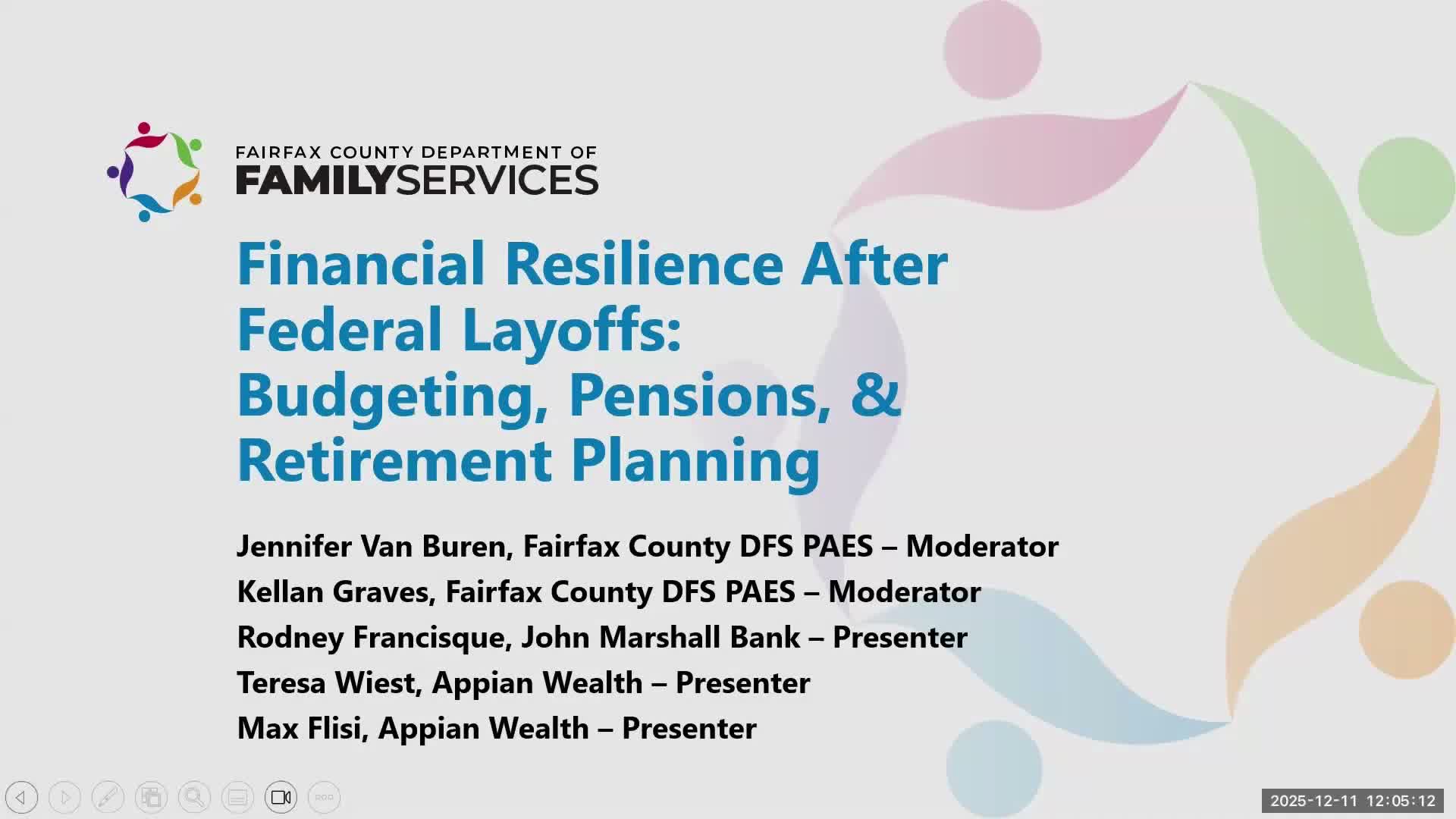
Summary
Fairfax County Department of Family Services held a one‑hour session titled “Financial Resilience After Federal Layoffs” where county staff and John Marshall Bank advised on budgeting, contacting creditors, debt-reduction and short-term savings options, and answered attendee questions about accounts and apps.
Fairfax County Department of Family Services hosted a one‑hour workshop titled “Financial Resilience After Federal Layoffs” that offered budgeting advice, debt-management strategies and short-term saving options for federal employees and contractors facing recent layoffs. Jennifer Van Buren, a manager in the county department, opened the session and Kellen Graves, supervisor of the Fairfax County Employer Engagement Team, moderated a Q&A from the chat.
The session’s main presenter, Rodney Francisco, branch manager at John Marshall Bank in Old Town Alexandria, walked through practical steps for immediate financial stabilization. Francisco said participants should first separate essential fixed costs — “housing cost, so rent or mortgage, car payment, or transportation costs, insurance” — from variable needs such as groceries and utilities, and to contact utilities and creditors proactively about hardship or budget plans.
Why it matters: layoffs reduce steady income for many county residents and contractors; local social services and community relief programs can provide short-term help, while budgeting and creditor outreach can prevent overdue accounts from accelerating financial harm. The event included a three‑question QR survey to identify attendees and invited follow-up appointments with bank staff.
Francisco emphasized concrete tactics: create a realistic written budget, prioritize high‑interest debt for payoff or consolidation, and consider professional guidance rather than risky debt‑settlement firms. He listed warning signs of unmanageable debt (for example, relying on minimum payments or having 20% of income go toward consumer debt) and advised building an emergency fund. On creating income, Francisco shared a personal example: after a layoff he started a commercial cleaning business and later returned to finance, urging attendees to assess marketable skills for consulting or gig work.
On short‑term savings vehicles, Francisco recommended money market or regular savings accounts for emergency funds and suggested short‑term certificates of deposit if money can be locked away. He cited a typical six‑month CD rate near 3.6–3.7% as an example; attendees should confirm current rates with providers. For tracking spending and cancelling recurring charges, Francisco named Rocket Money and Monarch Money and noted that Quicken and many bank apps also provide tracking tools.
Francisco also reviewed available resources: FDIC consumer guidance and the Money Smart program were cited as places to learn about consumer protections and budgeting. He concluded by offering one‑on‑one help through John Marshall Bank and displaying his contact information for attendees.
The moderated Q&A closed the session: Kellen Graves read chat questions and Francisco answered on accounts and apps. The workshop ended with a reminder about an end‑of‑session feedback survey and the availability of county resources for benefit relief. No formal votes or policy actions were taken.
Quotation highlights from the session include Francisco’s practical framing — “A crisis can be the push that reveals new ways to earn every extra dollar” — and the housekeeping instruction from Graves: “If you have questions, just go ahead and put those questions in the chat.”
Noted claims from presenters that were not independently verified in the session include Francisco’s statement about John Marshall Bank’s institutional history and an unelaborated remark that “we own the Nasdaq”; those claims were made on the record in the presentation but were not clarified or supported with documentation during the workshop.
The county invited attendees to complete a three‑question survey and to follow up via contact information posted during the presentation. The session was primarily informational and advisory; any participant seeking eligibility for relief programs or concrete application steps was directed to Fairfax County resources and individual financial counseling.