
Lehman symposium panel highlights stablecoins, custody and audit concerns for tokenized assets
Get AI-powered insights, summaries, and transcripts
Subscribe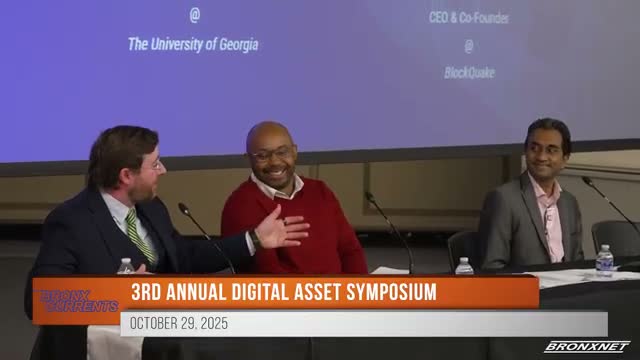
Summary
At Lehman College's Digital Asset Symposium, panelists said stablecoins and tokenization offer real efficiency gains but stressed auditors, qualified custodians and code reviews are essential after recent exchange collapses.
At Lehman College's third annual Digital Asset Symposium, panelists focused on real-world asset tokenization and stablecoins, arguing the technology can speed payments and broaden access while warning that weak audit practices and custody models still expose investors to fraud.
Panelist Antonio, cofounder and CEO of Blockway, described stablecoins as a major driver for tokenization and payments, saying they let value move nearly instantly: "I just paid someone in Dubai, $4,000 ... it was in their wallet in less than 5 seconds". He and other speakers said stablecoins that hold U.S. Treasury exposure could increase demand for treasuries and potentially strengthen the dollar.
Michael Thomas, a panelist who discussed creating blockchain curricula at the University of Georgia, emphasized that technology alone does not remove fundamental risks. Cautioning against superficial checks, he argued audits must examine reserves and business models, and code should be independently audited. "Proof of reserves" was dismissed as insufficient by panelists; Antonio said proof-of-reserve claims can be "proof of nothing" if not backed by verifiable legal ownership and third-party review.
Speakers also highlighted custody arrangements. Following the FTX and Celsius failures, panelists said institutional adoption will rely on qualified custodial structures that legally separate customer assets from operator claims. Antonio described a business approach to place exchange assets within a qualified custodian trust so customers retain legal ownership.
Audience members asked practical questions about wallets and estate planning for self-custody. Panelists warned self-custody requires users to manage private keys and plan for access in the event of incapacity or death; those who prefer not to manage keys may choose vetted custodians or exchanges that hold assets on their behalf.
The panel closed with examples of tokenized content. Michael described putting a traditionally published book "on chain" through a company called stuff.io to experiment with ownership, royalties and direct customer engagement.
The symposium's tokenization discussion underlined a central theme: the technology can reshape access and liquidity for assets, but adoption depends on stronger audit practices, clearer legal custody models and investor education. The program moved next to a panel on AI'driven disruption in film and accounting.