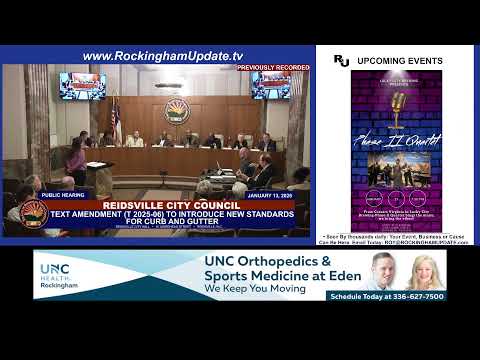
Reidsville council adopts amended curb‑and‑gutter rules after debate over conflicts and maintenance responsibilities
Loading...
Summary
After extended debate, Reidsville’s city council approved a text amendment to subdivision standards that creates density and watershed exceptions to curb‑and‑gutter requirements and requires tie‑in to existing storm infrastructure; the meeting included a contentious recusal discussion and public concern about who will maintain vegetated ditches.
Reidsville’s City Council voted in January to adopt a revised curb‑and‑gutter policy with an amendment requiring new subdivisions to tie into existing storm‑water infrastructure when practical, after a lengthy public hearing and internal debate.
Planning Director Drew Bigelow told council staff had proposed three exceptions to the city’s standard curb‑and‑gutter requirement: a low‑density exemption (single‑family under 6 units per acre; townhomes/multifamily under 8 units per acre), an exception for developments inside the Troublesome Creek watershed that would allow vegetated ditches in lieu of traditional curb and gutter, and administrative review by the Technical Review Committee (TRC) of engineered stormwater plans. Staff said tie‑in to existing curb/gutter where present would be required for expansions that could not meet any exception.
The item prompted a prolonged discussion about conflict of interest and recusal. Councilman Martin — who acknowledged he owns development property and has been involved in proposed downtown redevelopment — said he had received legal advice that he need not recuse himself for the citywide policy because it applies generally to all developers. Other council members disagreed and, after debate, a motion to recuse Councilman Martin for this item passed.
Public comment highlighted legal and operational concerns. Attorney Joseph Shuford, representing local developers, urged the council to remove the provision that would assign private property owners responsibility for maintaining vegetated ditches installed within the public right‑of‑way, arguing that such infrastructure is in public land and municipalities generally maintain public rights‑of‑way. Resident Frank Verdi urged strict adherence to state design standards and involvement of state environmental regulators.
Council ultimately approved the text amendment with a modification to require tie‑ins to existing infrastructure (the motion specified that the tie‑in rule remain even if an exception otherwise applied). Council and staff debated whether that modification required sending the amended language back to the planning board; counsel advised that only substantial changes require mandatory re‑referral. The council voted to adopt the amended policy and directed staff to implement the revision and proceed with the administrative process.
City staff said the TRC will review sealed, engineer‑prepared stormwater management plans and that vegetated‑ditch alternatives would require maintenance arrangements (staff‑recommended language leaves maintenance responsibility with property owners or homeowners associations unless the city assumes maintenance in a separate agreement). Attorney Shuford asked the council to reconsider the maintenance assignment, saying it posed legal and fiscal issues.
Next steps: staff will publish the adopted amendment language and update application guidance; site plans and subdivision reviews remain subject to TRC review, applicable state permits, and any DOT requirements for access.
Quote: Planning Director Drew Bigelow summarized the proposed exception framework: "An exemption from the curb and gutter requirement may be given for all new developments located in the Troublesome Creek watershed… in lieu of curb and gutter, however, vegetated ditch and culvert must be installed to handle potential stormwater runoff."