Get Full Government Meeting Transcripts, Videos, & Alerts Forever!
Get email alerts on the Special Events Policy topic
No spam. Unsubscribe anytime.
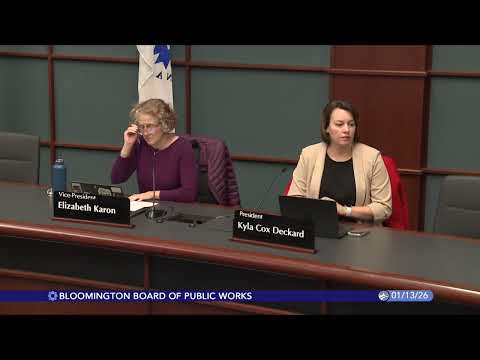
Bloomington board adopts downtown special-events policy; exempts Fourth Street Festival for 2026
Summary
The Board of Public Works on Jan. 13 adopted a policy standardizing three downtown festival footprints and fee procedures, citing public-safety benefits; the Fourth Street Arts Festival received a one-year exemption for 2026 after public testimony and staff compromise.
The Bloomington Board of Public Works voted Jan. 13 to adopt a new policy that standardizes downtown festival footprints and codifies permitting and fee procedures for events in the public right of way. The board approved the resolution with a commitment to review the policy in October 2026 and granted a one-year exemption allowing the Fourth Street Arts Festival to remain on Fourth Street for its 50th anniversary in 2026.
The policy, presented by Adam Wason, public works director, and Cassie Warney, special projects and operations manager, identifies three festival footprints—Kirkwood Avenue (Walnut to Indiana), Courthouse Square (Kirkwood to the south, Sixth Street to the north) and the Trades District north of City Hall—and adopts the existing fee schedule in the Bloomington Municipal Code, Chapter 12/12.1, to support partial cost recovery of event operations. "This allows for more contained and manageable closures, and establishing these footprints sets predictability for our public, public safety operations, and those that have to adapt during these street closures," Wason said.
Warney told the board the program had been decentralized and that the policy reflects research and conversations with other cities and local event organizers. She said the fee structure already exists in code and is intended as a "fractional" cost-recovery tool to help sustain event support such as water barricades and no-parking signs. "The fees that have existed in the code are exactly the fees that are in the code now associated with this policy," a board member confirmed during questioning; Warney replied, "That is correct."
Public comment centered on the Fourth Street Arts Festival, which many residents and artists urged the board to "grandfather" on Fourth Street. Pamela Davidson of the Fourth Street Art Fair board read a list of reasons to keep the festival on Fourth Street, citing the event's 50-year identity, mature shade trees and concentrated economic benefit to nearby restaurants. Juliet Roberts, president of the Fourth Street Festival, said patrons and artists have expressed concern about heat exposure on Kirkwood Avenue and argued that the festival's identity and the economic benefit to local restaurants are tied to its current location. "Fourth Street's mature shade trees materially improve safety, comfort, and crowd flow during late summer heat," Roberts said.
Staff and some speakers disputed attendance estimates cited by public commenters. Warney said the city's attendance platform (Placer.ai) showed about 1,700 attendees Saturday and 1,600 Sunday for the festival last year: "The attendance for for street festival for last year for Saturday was 1,700 and for Sunday was 1,600." Festival volunteers cited higher manual counts; the board did not adopt a separate estimate but acknowledged differences in methodology.
Board members framed the policy as a public-safety and consistency measure: bollards and other permanent infrastructure on the Kirkwood corridor are intended to provide a higher level of protection than temporary barricades. Wason said staff recommended the short-term exemption for the festival so organizers could plan for 2026 while working with the city on a transition for subsequent years.
The board's motion adopted the policy as presented and included a specific instruction that the Board of Public Works would review the policy again in October 2026. Minutes and written public comment, including a letter submitted by festival organizers, will be included in the public packet. The board did not take additional immediate changes to the policy; staff will incorporate feedback and return with the routine review and any amendments.