Get Full Government Meeting Transcripts, Videos, & Alerts Forever!
Get email alerts on the DOT Rules topic
No spam. Unsubscribe anytime.
CB2 hearing highlights clash over DOT clear-path rules as operators warn of lost outdoor seating
Summary
At a Jan. hearing, an applicant and several operators told Community Board 2 that DOT’s global pedestrian-clear-path rules could shrink usable outdoor seating and hurt summer revenue; committee members and staff explained measurement rules and urged applicants to resubmit accurate plans and pursue municipal or legislative remedies if needed.
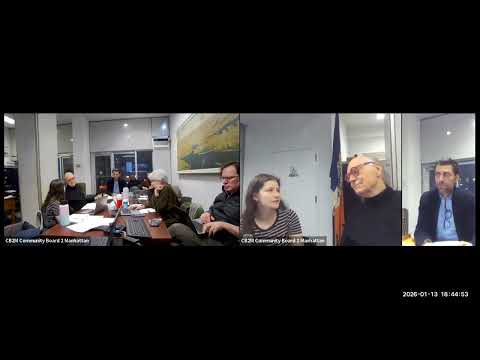
An extended exchange at Manhattan Community Board 2’s Jan. 2026 Outdoor Dining Working Group meeting centered on how city pedestrian-clear-path rules are measured and on what operators say is an unintended economic cost.
An in-person applicant for a resubmitted sidewalk-cafe application told the committee she had been told DOT sign-off permitted a 12-foot corridor but that staff and committee members interpret some obstructions (for example, tree pits) as requiring an 8-foot radius measured in all directions. Staff explained that the program applies a larger global corridor in some high-pedestrian locations, which can reduce the usable outdoor footprint for adjacent businesses. The committee asked whether the applicant had drawn tree-pit radii in the plan; the applicant said she had not and agreed to resubmit with measured clearances.
The applicant urged the board to advocate for local exceptions to a citywide, one-size-fits-all approach, arguing the rules could “kill the summer’’ for neighborhood cafes and reduce sales. The speaker offered an unverified estimate of a large revenue loss for a neighboring business; committee members did not accept that figure as verified and instead focused on technical compliance and next steps for the applicant.
Committee members recommended two paths for operators: (1) accurately model clearances and adjust seating to meet the applicable corridor and obstruction clearances, or (2) pursue programmatic relief (a local variance or a targeted program) through the council or DOT if an area’s built geometry makes standard clear-path rules impractical. Staff also reminded applicants to file the municipal 30-day expansion notice for any liquor-license changes.
The committee did not overturn the citywide standards; instead, it emphasized accurate, measured resubmissions so DOT can evaluate clearances and FDNY can review safety implications where necessary. Applicants were advised that once a plan is approved it must be followed, and that 311 or SLA channels exist for enforcement of noncompliance.