Mesa launches Office of Innovation and Efficiency to shift departments to outcome‑based KPIs
Loading...
Summary
City managers introduced the Office of Innovation and Efficiency and 'Performance Plus,' a program to move departments from output reporting to outcome‑based KPIs, dashboards and predictive analytics (permit turnaround, water main breaks, code compliance); staff promised pilot dashboards and council access ahead of further rollout.
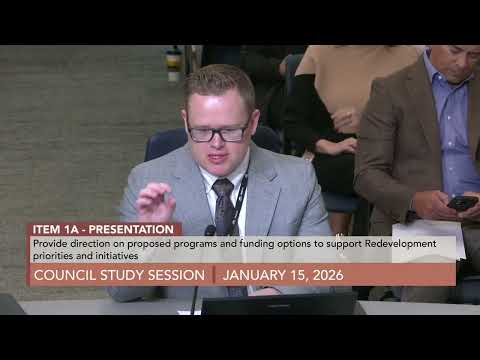
Mesa city staff on Jan. 15 introduced a reorganized Office of Innovation and Efficiency (OIE) and a Performance Plus initiative designed to embed data‑informed, outcome‑based decision‑making across departments. Ian Linson (assistant to the city manager), Evan Allred (chief data officer) and Michelle Trejo (performance administrator) described work already underway — from dashboarding and data governance to predictive models developed with Arizona State University — aimed at improving service delivery and targeting resources.
The case for change: "Being efficient is producing the intended community outcomes with minimal waste, delay or rework," Ian Linson said, describing the office’s purpose. Michelle Trejo said the initiative moves the city from outputs to outcomes and will create standardized dashboards linking departmental purpose statements to outcome KPIs, service delivery impact and budget impact tiles.
Examples and partnerships: staff highlighted ongoing analyses — permit turnaround and submittal bottlenecks, public‑records redaction timing, water and energy meter analytics, predictive models for code‑compliance case load and water‑main breaks, and pedestrian injury mapping — some developed with ASU. The team said they will pilot dashboards and make them available to council in the coming months, while cautioning that enterprise‑scale AI and prediction work requires continual validation.
Council questions and governance: Council members pressed who sets and validates KPIs; staff said department directors, assistant city managers and the city manager will align KPIs with council priorities and that the OIE facilitates KPI development and reporting. Members asked for a 'sandbox' preview of dashboards before final rollout and for external validation of predictive models; staff agreed to provide early access and said the city audit team and external partners can be involved in validation.
Next steps: OIE will continue department partnerships (30 departments in initial work), establish KPIs and dashboard templates, and provide pilot dashboards to council ahead of broader rollout. Staff said they expect progressive improvement over multiple budget cycles and emphasized an iterative, data‑informed approach rather than blind reliance on models.