Mesa staff propose $3 million‑a‑year redevelopment pilot to tackle blight and unlock infill
Loading...
Summary
City staff presented a redevelopment 'toolkit' that includes vacant‑property registration, code‑compliance assistance, revolving loan and remediation funds and a proposed $3 million annual pilot; staff will pursue federal grants (EDA, Brownfield) and return with detailed design and funding options for the budget cycle.
Mesa city staff on Jan. 15 presented a package of programs aimed at speeding private investment in underperforming commercial properties and reducing the public costs of blight. The proposed toolkit includes a vacant‑property registration, a code‑compliance assistance program, a revolving loan fund, targeted commercial activation grants, public infrastructure support and environmental remediation assistance. Staff recommended a $3,000,000 annual pilot over five years and said it will seek federal grants, including an Economic Development Administration (EDA) award, to augment local funding.
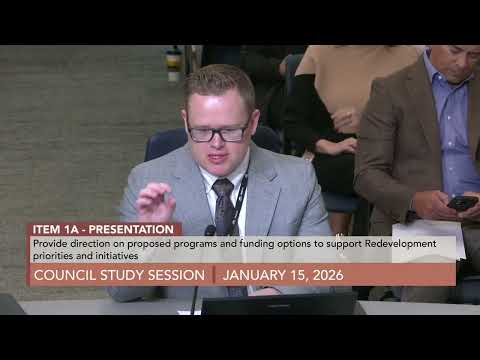
Staff framed the effort as a response to long‑term disinvestment. "For the past 2 years, council has identified redevelopment as a key strategic priority of the city," Jeff McVay, manager of Urban Transformation, told the council, describing a cross‑department team and a 30% design for the proposed tools. Angelica Guevara of code compliance described a long‑running enforcement case — the Indy Car Wash property — and said the city’s abatement and related costs already exceed "over $30,000". Guevara said staff has pursued citations and criminal charges (misdemeanors) and is exploring foreclosure on liens where owners do not pay abatement costs.
Why it matters: staff said small, targeted interventions can reverse decline and reduce repeated enforcement costs, calls for fire and police service and lost tax revenue. Staff emphasized that many redevelopment barriers are informational or technical — for example, uncertainty about historical contamination that deters lenders — and outlined a remediation path that often begins with a phase‑1 record search and, if needed, phase‑2 testing. Jeff McVay cited a downtown example where an ADEQ grant of about $30,000 allowed the city to test soil and clear a site so it could be sold and redeveloped.
How the programs would work: the vacant‑property registration would collect contact information to speed notifications and coordinate with Mesa Police; code compliance assistance would offer timing extensions and potential cost‑sharing (staff floated match examples such as 50/50 or 70/30) for large visible repairs; a revolving loan fund would target the lending gap between microloans and bank underwriting and staff said they would pursue an EDA seed grant (goal: $2,000,000) and partner with a CDFI or third‑party underwriter rather than manage loans directly; public infrastructure funding would help pay for off‑site utility upgrades that make small sites feasible for private reuse.
Funding and timeline: staff recommended treating the initiative as a five‑year pilot with a $3,000,000 annual allocation (a $15,000,000 five‑year total) drawn from a mix of federal grants, redevelopment revenues and one‑time construction‑activity set‑asides rather than a new tax. "We would like to seek federal funding sources first whenever possible," staff said. If approved to proceed, staff said they would return with 90% program design, allocation recommendations for the initial $3 million and KPIs for annual reporting; staff also said they are exploring a Brownfield grant and other federal sources.
Council reaction and conditions: members welcomed the toolkit but pressed for budget detail and firm criteria. Council asked whether the allocation would be a taxpayer ask (staff said it would be funded with one‑time construction revenue and grant sources where possible) and asked for clearer qualification criteria for awards and conditions attached to assistance (for example, development agreements or liens to protect public investment). Legal staff clarified that the administrative warrant staff seeks will be a judicial warrant issued by a judge; code compliance staff said they expect to finalize warrant procedures in roughly 2–3 months.
Next steps: staff will refine program mechanics, identify funding sources and stakeholder feedback, and return during the budget process with a detailed funding recommendation and program design. Council directed staff to continue outreach to property owners, developers, the Chamber and potential third‑party partners and to prepare KPIs and annual reporting for the pilot period.
Reported actions and outcomes: no final appropriation or ordinance was adopted during the study session. Council heard the presentation, provided feedback and asked staff to return with the detailed program and budget recommendations.