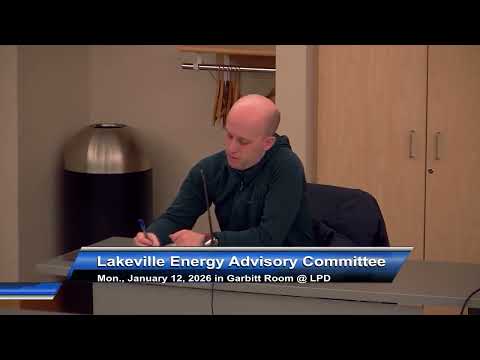
DOER official outlines Climate Leaders program and funding opportunities for Town of Lakeville
Loading...
Summary
Lisa Sullivan of the state Department of Energy Resources described Climate Leaders certification, eligibility criteria and grant opportunities — including technical assistance and competitive grants — and urged Lakeville to weigh policy changes (ZEV‑first, specialized opt‑in code) before applying.
Lisa Sullivan, Southeast Regional Coordinator for the Department of Energy Resources’ Green Communities program, told the Town of Lakeville Energy Advisory Committee on Jan. 12 that the Climate Leaders program builds on Green Communities and offers technical assistance and competitive grants to help municipalities decarbonize municipal buildings and fleets.
Sullivan framed the program around Massachusetts’ statutory goals and planning work, noting the state’s 2050 net‑zero target and interim milestones. "The pathways to decarbonization are to electrify your buildings, electrify your vehicles, clean up the grid, and sequester carbon," she said, placing municipal action in the context of statewide targets.
Why it matters: Climate Leaders certification can unlock a package of planning support and larger grants that help towns advance projects they might otherwise defer because of cost or procurement complexity. Sullivan said Lakeville is a long‑standing Green Community and listed recent grant totals the town has drawn down; new program elements would let the town pursue larger decarbonization projects with state help.
Key program points
- Eligibility and criteria: Sullivan said Climate Leaders is optional and requires a municipal decarbonization commitment (a resolution or similar), a decarbonization roadmap prepared with assigned technical assistance, an active local climate/energy committee, a ZEV‑first purchasing policy and adoption of the optional specialized opt‑in building code via town meeting if the town chooses to pursue that path.
- Funding opportunities: Sullivan described several funding tiers: competitive Green Communities grants (she referenced awards in the ballpark of $225,000), multiyear decarbonization grants (discussed up to $500,000), a $150,000 technical assistance grant to develop large applications, and an accelerator grant opportunity discussed at roughly $1,000,000. She said the DOER posts program opportunity notices on COMMBUYS and runs regular rounds; the committee was told an upcoming spring competitive round lists an application date of 04/10/2026.
- Timing and administrative requirements: Sullivan advised the committee that Lakeville must close any open Green Communities grant (file final reports and invoices) by 02/13/2026 to be eligible for the spring competitive round. She warned that municipal projects in MLP (municipal light plant) communities can take longer because of procurement rules and recommended using DOER technical assistance to prepare bids and scopes.
- Practical policy guidance: Sullivan recommended adopting a ZEV‑first purchasing policy that asks whether a battery electric or plug‑in hybrid vehicle would meet a given municipal use before defaulting to gasoline; she noted exemptions remain for emergency response and very heavy vehicles until supply and charging infrastructure catch up. On building codes she advised that the specialized opt‑in code applies to new construction only and that towns planning to adopt it should provide at least a six‑month lead time and do public education for builders and planning boards.
Local context and examples
Sullivan told the committee Lakeville is "specially eligible" under Green Communities rules because of long‑standing energy savings performance and so may qualify for some enhanced opportunities in competitive rounds. She urged the town to consider pairing DOER grants with other sources (MSBA, local capital, utility rebates) when contemplating large projects such as new schools, a new fire station or a municipal microgrid.
Next steps discussed at the meeting included DOER sharing presentation materials and the committee pursuing a town resolution or roadmap only if town leadership (manager/select board/town meeting) supports that policy direction. Sullivan offered to provide examples of successful grant applications and to answer follow‑up questions.
What remains undecided: Sullivan noted several practical hurdles for an MLP community — especially slower timelines for procurement and the need for municipal buy‑in — and said the town should first decide whether the policy commitments (ZEV‑first, opt‑in code, formal resolution) match local priorities before filing large grant applications.