
WICO tells Senate it owes $11.8M in pilot liability, pledges 60-day study and partial payment plan
Get AI-powered insights, summaries, and transcripts
Subscribe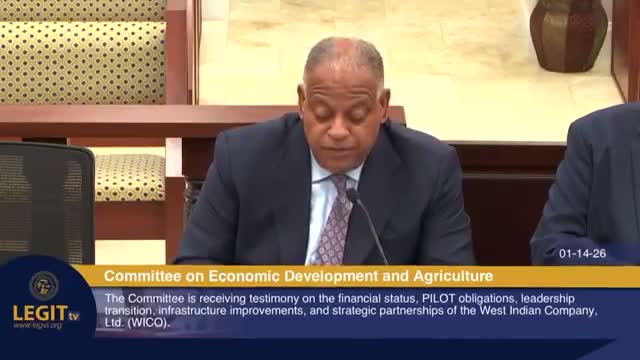
Summary
West Indian Company Limited (WICO) told the Senate Economic Development & Agriculture Committee it carries about $11.8 million in unpaid payment‑in‑lieu‑of‑taxes (pilot), reported a $2.6 million net loss in FY2025 and committed to provide a study and a pilot-payment proposal within 60 days.
Joseph Bushelty, president and CEO of the West Indian Company Limited, told the Senate Economic Development and Agriculture Committee on Jan. 14 that WICO continues to play a central role in the U.S. Virgin Islands’ cruise economy but is carrying a substantial unpaid pilot liability.
Bushelty said WICO reported approximately $9.4 million in revenue in fiscal 2025, with operating expenses near $6.2 million and a net income loss of about $2.6 million. "YCO's outstanding pilot liability currently totals 11,800,000.0," he told senators, describing how COVID‑era shutdowns and hurricane damage worsened cash flow that already strained the company’s ability to meet a statutory minimum pilot set at the greater of 10% of revenues or $700,000.
Senators pressed WICO on accountability, the company’s use of federal relief, and long‑delayed capital projects. Senator Hubert L. Frederick reiterated the committee’s expectation that WICO show good‑faith payments to the territory: "We want to make sure good faith effort is being made to follow the law," he said. Senator Alma Francis Heiliger and others pressed Bushelty to explain why payments have not been made despite revenue increases.
Bushelty said WICO has reduced some operating expenses, is pursuing revenue diversification beyond cruise passengers, and is advancing maintenance projects for docks, fenders and the water system. He described ongoing work to revitalize Havenside property, explore hotel and experiential retail opportunities, and pursue federal grants. On the Katherineburg renovation, Bushelty said FEMA funding discussions have occurred and that approximately $1.5 million in FEMA funds are earmarked for renovation work.
On the pilot specifically, Bushelty asked the Senate to consider a revenue‑tied, equitable approach: he said the current statutory floor makes cash‑flow compliance difficult when the company operates at a loss. He committed to present the committee with a study and a recommended pilot number within 60 days and said the board intends to make a payment in fiscal 2026 if projections hold. "If you give us this number, senators, we will have it on our budget. We'll work with our board ... and make it happen," he said.
Mark Sabino, WICO director of marine and cruise services, told the committee the primary operational constraints are berth capacity and dredging: "The capacity and lack of dredging is our primary challenge," he said, adding that longer ships and industry growth have brought capacity constraints that require investment.
The committee requested WICO supply audited figures, a detailed 60‑day pilot proposal and progress updates on Katherineburg and bond‑related debt service. Senators emphasized the need for accountability even as they acknowledged WICO’s central role in the territory’s tourism recovery.
Next steps: WICO has agreed to deliver the pilot analysis and proposed payment options within the committed timeframe for the committee’s consideration.