
San Mateo supervisors pick charter review panel, debate whether to direct committee’s agenda
Get AI-powered insights, summaries, and transcripts
Subscribe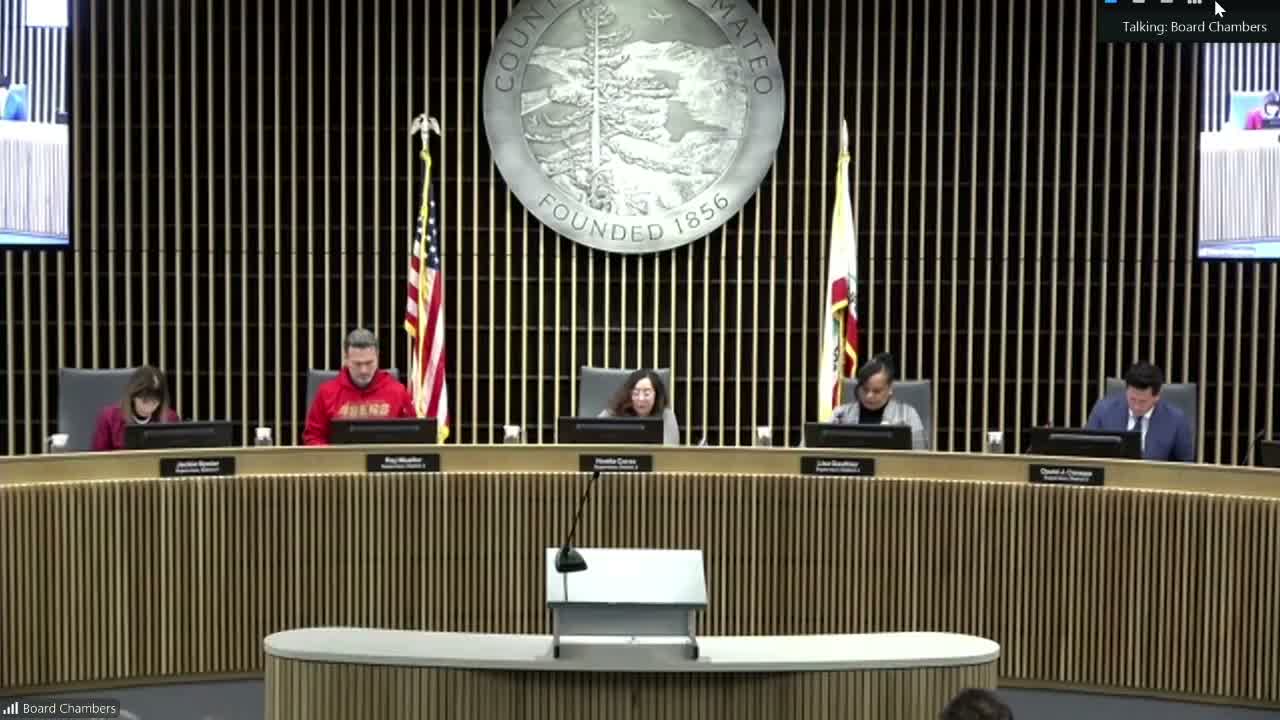
Summary
The Board of Supervisors approved appointments to a 2026 Charter Review Committee after tallying district and community‑interest nominations; supervisors split over whether the board should formally direct topics for the committee to study.
The San Mateo County Board of Supervisors on Jan. 13 approved appointments to the county’s 2026 Charter Review Committee and voted to allow the committee to meet remotely after its initial in‑person convening.
President Corso told the board the committee is required every eight years and ‘‘will be tasked with reviewing the county charter and after convening public hearings, making recommendations to the board of supervisors as to amendment[s] or revisions.’’ The board adopted a resolution incorporating district designees and 11 community‑interest slots drawn from more than 40 applicants the county received during the application period.
Why it matters: A charter review committee is the formal body that evaluates whether the county charter should be amended and which changes, if any, the board may advance to the ballot. Board direction to the committee can influence what issues it studies and the timeline of public hearings.
What happened: County Attorney John Niblin described a worksheet process by which each supervisor wrote down nominees for defined community‑interest categories; clerks read a tally of supervisor choices aloud and the board negotiated a few add‑ons before voting. Brian Pettit, deputy county attorney, said the committee in 2018 had 19 members, which the board used as precedent while selecting the current panel.
The board discussed — at times sharply — whether to include specific topics in the resolution directing the committee. Staff recommended five topic areas for consideration, including whether to eliminate a sunset provision for the board’s power to remove an elected chair (county charter section 4.12.5), whether to revise term limits language (section 2.02), requiring an annual review of the board’s governance practices, clarifying appointment procedures for filling elected vacancies (section 4.15), and adding procedures to address incapacity of elected officials.
Supervisor Mueller said he was uncomfortable with the board collectively directing the committee’s work, warning that it could feel like a top‑down mandate; other supervisors said the charter contemplates board direction and that supervisors may also send individual letters to outline topics they want studied. The final motion bifurcated approval of the panel from any directive topics; the board approved the appointments and the remote‑meeting findings on a roll call vote (Spear Aye; Mueller Yes; Gauthier Yes; Canapa Aye; Corso Yes).
Who is on the panel: The tally incorporated five district appointees already named by supervisors and 11 community‑interest slots; the clerk’s tabulation listed nominees such as Eddie Flores for cities, Lynette Garcia for schools, Julie Lind for organized labor, Karen Chapman for environmental groups, Kimberly Wu for immigrant‑rights groups, and others. Board members added three additional representatives (a veteran, a Pacific Islander representative and a League of Women Voters designee) to better reflect missing voices.
Public input: Multiple members of the public commented during the item, some objecting to the charter process on constitutional grounds and others urging broad representation. Several speakers raised concerns about the county’s governance and the board’s recent appointment of an interim sheriff; those comments were recorded during the public‑comment period but did not change the board’s votes.
What’s next: The committee will begin meeting and holding public hearings. Any charter amendment would require further board action and, ultimately, voter approval if the board places a measure on the ballot.