
Appropriations committee advances repeal of Wyoming Business Council after hours of debate and amendments
Get AI-powered insights, summaries, and transcripts
Subscribe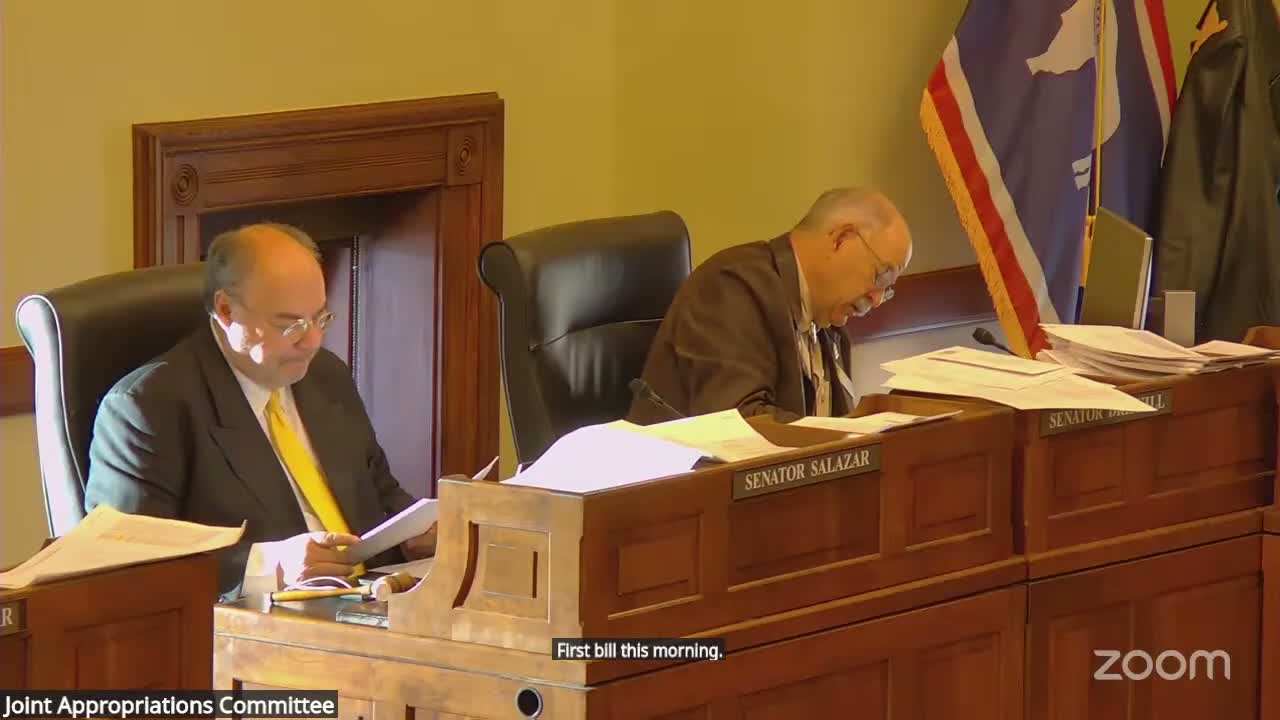
Summary
The Joint Appropriations Committee advanced 26LSO394 to repeal the Wyoming Business Council, transferring most programs to other state agencies, adding a forensic audit of council funds and ordering funds and some programs moved to other departments; vote was 9–3. Key questions remain about contracts, federal matches and program continuity.
The Joint Appropriations Committee voted to advance 26LSO394, a bill that would repeal the Wyoming Business Council and transfer most of its programs and assets to other state agencies, after extended technical review, public testimony and a series of amendments.
LSO staffer Mister Fuller, who presented the draft, told the committee the bill was written broadly to capture programs, assets, obligations and conforming amendments; non‑codified sections were drafted to take effect immediately to prevent the council from accepting new applications. Fuller said the repeal would take full effect on 07/01/2026, with many functions and funds to be transferred to the state budget department or, for two programs, to the Wyoming Energy Authority. He told members the bill creates a handful of exceptions (for example, a broadband subaccount that would be moved to the governor’s office) and includes reporting and wind‑up requirements for outstanding loans, grants and obligations.
Why it matters: the measure would dissolve an agency that has administered revolving investment funds, grants and loan programs for more than two decades, affects roughly 40–45 employees according to staff estimates, and reassigns programs and hundreds of millions in state and federal funds. Members raised practical questions about who will administer outstanding loans and bonds, whether private matching funds and federal grants would be preserved, and how lease or contract liabilities would be handled if the council terminates. Fuller recommended adding narrow clarifying language (for example to allow the council to accept loan repayments during wind‑up), and the committee adopted several technical conforming amendments.
Public testimony was sharply divided. Randall Luthy, policy director for Governor Gordon, told the committee the proposal felt rushed and urged an interim process and task force approach: "Frankly, mister chairman... this is nuts. This is crazy. It smells bad," he said, adding the administration preferred a staged, collaborative review. Sarah Dorenzo, deputy policy director for the governor, echoed a request for an orderly, collaborative approach and encouraged outreach to communities and economic developers.
Backers on the dais described the council as ineffective and said state government has a role in reshaping economic development tools. Sponsor Senator Larson said he brought the bill because some constituents felt the council 'picks winners and losers' and was not delivering for all communities.
Key changes adopted: the committee added 'financial aid' across relevant sections so the bill would include defined grants/financial instruments; it inserted a requirement for a forensic audit funded from an appropriation to identify any private or local funds and provide options to return or redirect those funds; it required transfer or reversion language for unexpended funds and clarified that certain statutory accounts (for example, the revolving investment fund accounts created under Article 16, Section 12) would be administered by the state budget department; and it added provisions addressing tourism account transfers. Members also approved conforming provisions moving two programs to the Wyoming Energy Authority and allowing the state budget department to assume outstanding obligations.
Formal outcome: the committee voted to advance the measure as amended. The roll call recorded: Senator French Aye; Senator Garou No; Senator Larson Aye; Representative Aleman Aye; Representative Angelos Aye; Representative Harrelson Aye; Representative Pennegrath Aye; Representative Sherwood No; Representative Smith Aye; Co‑Chairman Baer Aye; Chairman Salazar Aye; (result announced as 9 Aye, 3 No). The clerk recorded the vote and the chair confirmed the measure will proceed as a Senate bill.
Outstanding questions and next steps: members repeatedly asked for inventories of outstanding loans, bonds and contractual obligations and whether the repeal could imperil federal matches tied to state funds. LSO will incorporate the committee's amendments and clarifying language; the measure will move out of appropriations with the committee's recommendations and be available for the full legislature. The forensic audit, disposition of private donations, and the timing for moving staff and positions remain open and are expected to be addressed as the bill proceeds.
The committee recessed briefly after the vote and moved on to the rural health transformation item on its agenda.