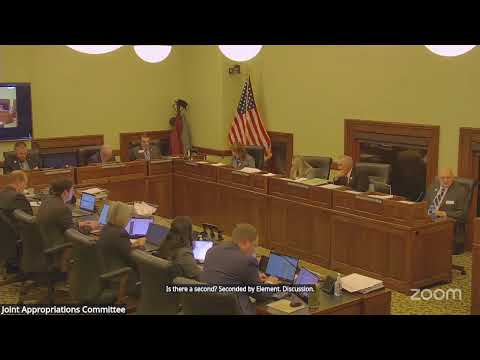
Appropriations committee advances capital construction bill language, rejects a $16M rare‑earths grant amendment
Loading...
Summary
Committee moved capital construction projects into a standalone bill with targeted footnotes (veterans home owner’s representative, major maintenance direct appropriations) and rejected a tied amendment to provide $16–17 million in state grants for a rare‑earths processing plant after a 6–6 tie.
The Joint Appropriations Committee moved to package capital construction projects into a stand‑alone bill and adopted a set of procedural footnotes and authorizations that will appear in that bill. During public comment, the Associated General Contractors of Wyoming urged the committee to proceed with maintenance and several projects, including the veterans home in Buffalo; the committee subsequently approved language to allow up to $500,000 to be spent on a qualified owner’s representative for the Buffalo Veterans Home project.
The committee adopted a footnote directing state parks and cultural resources to receive a direct appropriation for major maintenance (rather than routing the funding through the state construction department) to avoid a B‑11 process. Members also agreed to authorize college construction projects up to their estimated costs rather than leaving them unlimited, and to specify funding source priorities (general fund with the LISRA as backup) for capital projects going into the standalone bill.
During the capital construction discussion, Senator Driscoll (and other members) proposed an amendment to provide $16–17 million to the Wyoming Energy Authority to support a rare‑earths processing plant/demonstration facility in Upton and keep a local demo plant operating. The amendment prompted debate over whether the state should give grants to a private project, take an equity stake, or rely on federal support for a sector that has national‑security importance. The amendment failed on a 6–6 split.
What happens next: staff will draft the standalone capital construction bill and the committee indicated they expect to consider it in early February; approved footnotes and authorizations will be incorporated into that draft.