Consultant tells Rhinebeck board Asher Dam spillway and ice-load stability fall short of current standards; three concepts and removal discussed
Loading...
Summary
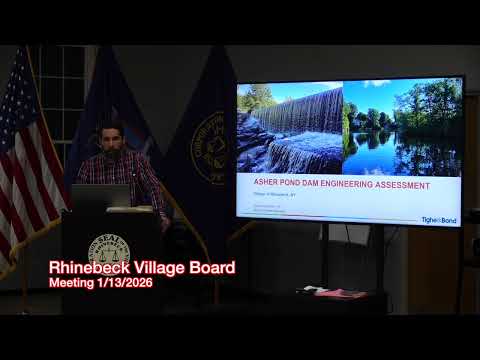
Tye & Bond presented a $49,500-funded engineering assessment for Asher Dam that found the spillway lacks required hydraulic capacity for the design storm and the dam fails the ice-loading safety factor. Consultants described three conceptual fixes and said dam removal could be included as an alternative; the draft will be submitted to DEC for review.
Tye & Bond engineer Dan Valentine told Rhinebeck trustees that the Asher Dam (Asher Pond) engineering assessment identified two primary deficiencies: the spillway does not have the hydraulic capacity required by the design storm used in the analysis, and the dam lacks adequate factors of safety under the ice-loading case. The assessment, funded by a nonpoint-source planning grant of $49,500, was presented at a January meeting and will be submitted to the New York State Department of Environmental Conservation for review.
Valentine described the dam as a stone-masonry structure with a concrete crest roughly 86 feet long and about 13 feet high, located on the Landsman Kill adjacent to Legion Park. The report classified the dam as a Class B (intermediate) hazard dam — meaning regulatory standards are conservative because failure could cause significant downstream damage (Valentine said roughly 15 homes and Route 9 could be affected in a failure scenario). He emphasized that condition (visible defects) and hazard classification (consequence if it fails) are distinct.
The hydrologic/hydraulic review used a design storm described in the presentation as about 12.35 inches of rain in 24 hours (the presenter corrected an earlier misstatement). Findings: low-level outlet drains meet current standards; the spillway does not meet the DEC design-storm capacity and would be overtopped in the evaluated storm; structural stability analyses met factors of safety except under the theoretical ice-load case.
Valentine described three conceptual improvements that would meet current standards: (1) lower the daily pond/spillway elevation by about 1.7 feet, widen the spillway to roughly 100 feet and raise the park grade near the shoreline; (2) greatly extend the spillway length with a rip-rap channel to increase pass-through capacity; and (3) a hybrid multi-stage spillway with a modest lowering, a shorter primary spillway and an auxiliary spillway for extreme events. He said each concept could be designed to meet DEC/USACE standards for stability and hydraulic capacity. Valve/drain rehabilitation already completed during the project improved the village's operational ability to lower the impoundment before storms.
The board discussed dam removal as a feasible community alternative. Valentine said removal would eliminate dam maintenance and associated village liability and could be included as an alternative for DEC review, but that removal is a community decision and carries environmental and landscape implications that require study and permitting.
Valentine outlined next steps: submit the draft assessment to DEC, incorporate feedback (including adding a removal alternative if the village desires), and proceed to preliminary design, permitting and funding. He gave a rough schedule — approximately a year for design and permitting and a year for construction — and emphasized that further work is funding-dependent. He estimated that the types of improvements discussed would range in cost from hundreds of thousands to multiple millions of dollars depending on scope.
Quotes from the meeting include: "The spillway does not meet the current standards for hydraulic capacity," and "It does reduce the liability of the village if the dam were to fail" (on dam removal as an option). The presenter noted that the dam has been in place for more than a century and that the analysis is conservative by design.
Provenance: the presentation, technical findings, alternatives and next steps were discussed in the engineer's presentation and the Q&A during the board's January meeting.