Springfield CPC workshop reviews CPA eligibility, historic-home lottery and Feb. 26 application deadline
Loading...
Summary
City staff and committee members detailed what projects qualify for Community Preservation Act funds, explained the historic-home lottery and application requirements, and said applications are due Feb. 26 with seven paper copies plus a digital submission.
At a public workshop, Springfield City staff outlined how residents and organizations can apply for Community Preservation Act (CPA) funds for open space, historic resources and community housing and reminded applicants that full applications are due Feb. 26.
"CPA is a Massachusetts law that passed in 2000 that helps cities and towns preserve the character of their communities through a dedicated fund for open space and outdoor recreation, historic resources, and community housing," said Bob McCarroll, who led the presentation. He said Springfield voters adopted CPA in 2016 and that the committee has recommended roughly $20 million to City Council across eight funding cycles. McCarroll said Springfield's annual CPA budget is about $3,000,000.
Why it matters: CPA money is one of the few locally controlled funding sources dedicated to parks, historic preservation and affordable housing. The rules that govern what the committee may fund are set by state law and by the committee's annual plan; applicants who understand eligibility and documentation requirements are likelier to prepare competitive requests.
State law and eligible uses: Staff reviewed Chapter 44B of the Massachusetts General Laws, which frames four eligible activities: open space, historic resources, community housing and outdoor recreation. McCarroll emphasized that many CPA-eligible activities are land-focused: acquisition, creation, preservation, rehabilitation and restoration of eligible real property. He said the law requires the community to reserve at least 10% of annual CPA receipts for each of housing, historic preservation and open space/recreation and allows up to 5% for administration.
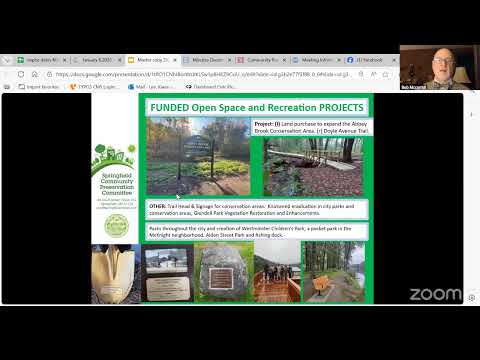
Examples in Springfield: Staff cited local projects that used CPA funds, including acquisition to expand the Abbey Brook Conservation Area, a vest-pocket children's park on Westminster Street (McKnight neighborhood), invasive-plant eradication work in parks, and upgrades at Blunt Park and Hubbard Park. For historic resources, staff noted work on Bay Path Cemetery, the Spanish-American War Memorial and projects with the Springfield Preservation Trust and the Springfield Museums.
Historic-homes lottery and amounts: The committee described its historic-homes program, which uses a live randomizer drawing of addresses from seven local historic districts. Karen, who explained the application sequence, said the committee has capped the program at 200% of area median income (AMI) for this cycle. She gave the program's grant range: a stated maximum of $330,000 and a minimum award of $15,000 (scaled so higher AMI applicants receive smaller awards).
Housing rules and restrictions: Staff explained that community housing projects must meet income limits tied to HUD'derived AMI figures, and that for rehabilitation projects a legal affordability restriction (a deed restriction) is typically required when CPA money creates or preserves affordable units. McCarroll warned that CPA'funded rehabilitation of existing housing is limited unless the housing was previously acquired or created with CPA funds.
Application process and documentation: Karen walked through the digital application and required attachments: project title and address, program area selection, project budget, committed funding sources (enter 0 if none), parcel ID and map (via the city GIS), professional cost quotes, and a maintenance plan for parks or municipal projects. Non-municipal grant requests over $50,000 require a fair-wage compliance certificate. In addition to the digital submission, applicants must provide seven paper copies or mail a paper application to the Election Office (Room 25) postmarked by Feb. 26.
Reimbursements and inspections: The committee will reimburse grantees after work is completed and verified: an inspection and proof of payment are required before funds are released. Staff acknowledged that reimbursement can be challenging for smaller applicants but said the CPC can work individually with applicants where necessary.
Questions and next steps: Staff encouraged applicants to contact the parks department or CPC staff for application help and said they will post materials on the Springfield City Hall website and provide links (including to the Massachusetts Preservation Coalition for AMI data). The committee scheduled a February meeting to continue CPC business and said legal guidance from the city law department will be sought for questions about monitoring and deed restrictions.
"The applications are due on February 26, and you can either mail them to us or you can drop them off at the Election Office," Karen said. "Please do not drop the applications in the voting box located outside of the building because that's happened before. Bring them inside."