
Baltimore County police describe new electronic protective‑order routing to speed service
Get AI-powered insights, summaries, and transcripts
Subscribe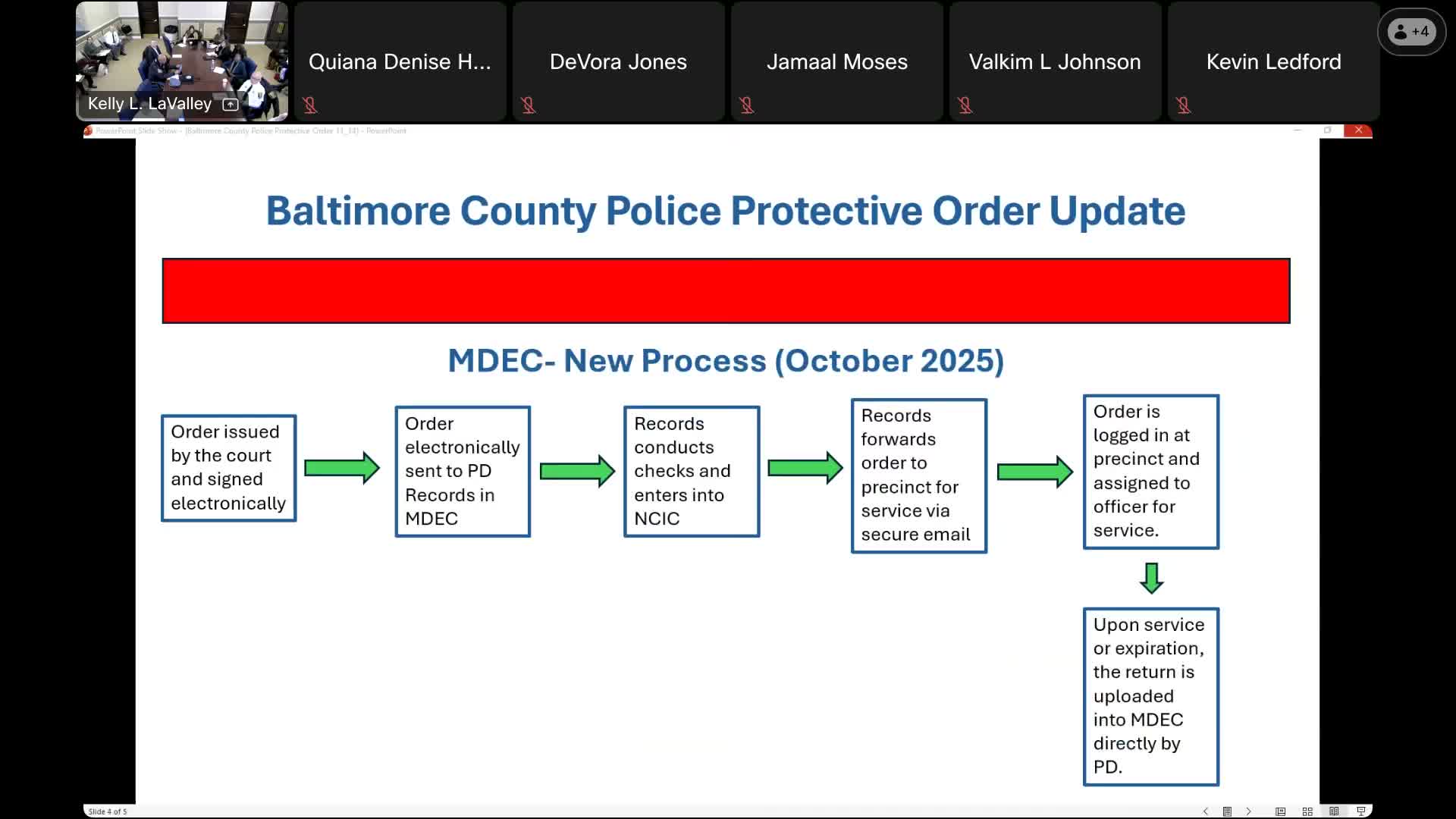
Summary
Baltimore County police told a domestic violence committee the county and Maryland courts have implemented an electronic transmission pipeline so signed protective orders route directly to a monitored police records inbox, reducing manual relay delays and allowing earlier service attempts and preliminary record checks.
Major Fisher of the Baltimore County Police Department told the Domestic Violence Committee that the county has implemented a new electronic transmission process so that protective orders signed by a judge are routed directly from the court’s electronic inbox to police records. “Once that order is signed electronically, it’s able to be sent electronically to the police department,” Major Fisher said during the committee meeting.
The change replaces a manual relay that once required clerk offices, the 9‑1‑1 center, officers in the field and records staff to exchange paper or faxed orders. According to the presentation, those handoffs sometimes produced delays of hours before an officer could attempt service. Major Fisher said the manual process created a heavy workload for the three main stakeholders — the courts, the police department and the 9‑1‑1 center — and traced planning meetings on the project back to January 2023.
Committee members said the new workflow was designed to reduce that burden. Under the new system, the judge’s signed order appears in the judiciary inbox and is transmitted via an encrypted pipeline to Baltimore County police records, which the department monitors continuously. That inboxing allows records staff to log the order immediately, run a preliminary records check to identify any cautions or safety concerns for officers, and alert precinct officers to attempt service more quickly.
“The 9‑1‑1 center was a huge partner,” Major Fisher said, describing work to remove the manual relay from the emergency call flow so communications staff can focus on emergency operations while orders go directly to police records.
Major Fisher also described technical and interagency steps taken to enable the transmission. County information‑technology staff built a secure connection between county systems and the Maryland judiciary to mitigate earlier cybersecurity concerns about sending court documents to county email systems. The circuit court clerk’s office, referenced in the presentation as led locally by Judd Robinson, and the sheriff’s office were described as supportive during testing and the early rollout.
The department said it will begin tracking measures such as time‑to‑serve and first‑attempt success rates to quantify improvements. A precinct‑level summary shown to the committee indicated higher volumes in central precincts and in areas near the county detention center, which the department said has sometimes allowed grouped service of multiple orders for incarcerated individuals.
Committee members and staff praised the change and reported external interest: one participant said administrative judges and other counties, including Frederick County, have sought information about adopting the same process. Committee participants said the automation freed officer time previously spent relaying orders; one attendee referenced prior volumes tied to order relays and noted the shift has reduced that workload.
A committee member asked whether extreme risk protective orders are included in the launch; Major Fisher said the initial launch may not have covered every order type and that some categories were not part of the first release. He said the team will continue to work with Judicial Information Systems and other partners to address remaining timing and jurisdictional differences.
The committee did not take any formal votes on the transmission project during the meeting. Major Fisher said the department will report back with metrics and further rollout details at a future meeting.
The Domestic Violence Committee scheduled a follow‑up discussion of related DV topics at its February meeting.