
Mount Sinai UFSD highlights new STEAM lab and K–5 science curriculum
Get AI-powered insights, summaries, and transcripts
Subscribe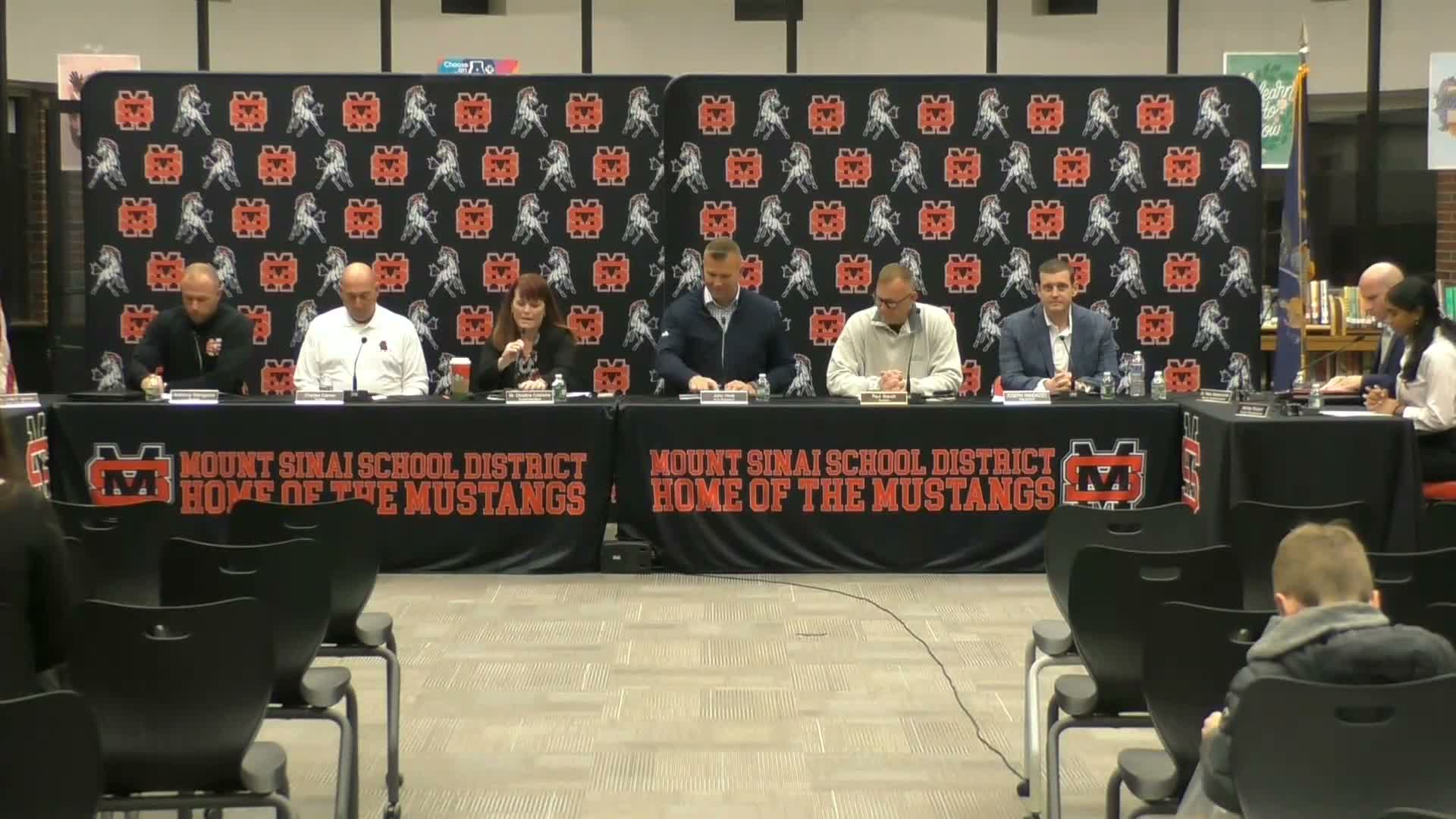
Summary
Superintendent highlighted a newly created STEAM lab and K–5 curriculum work driven by the New York State Science Learning Standards; staff described hands-on units, teacher guides, and professional development supported by a legislative grant.
Mount Sinai Union Free School District Superintendent Dr. Piccione opened the board meeting by introducing elementary assistant principal Megan Teppenhart and STEAM facilitator Allison Elfreth, who presented a progress report on the district’s elementary STEAM program and a newly established STEAM lab.
The presenters said the district reviewed existing curriculum resources and teacher feedback and used grade-level teams and backwards design to craft NGSS-aligned units. “The STEAM lab has really been kind of the hub of our building for this year,” a presenter told the board, saying the lab provides a dedicated space for hands-on lessons and engineering-design activities that are difficult to execute in a regular classroom setting.
District staff said the work is guided by the New York State Science Learning Standards (referred to in the transcript as “NSLIS”) and emphasized three-dimensional learning—science and engineering practices, disciplinary core ideas, and crosscutting concepts. Presenters described classroom examples, including a third-grade unit anchored on the Sunken Meadow Estuary and a kindergarten unit using melted crayons to illustrate phase change; they noted those phenomena are used to anchor storylines and authentic student investigations.
The team described curriculum products under development: teacher guides with step-by-step sequences, student-facing materials, labs that incorporate engineering design, and monthly mini-workshops for teachers aimed at building assessment capacity (formative and summative tools) and instructional consistency across grades. Presenters highlighted student inquiry moments—kindergartners devising experiments about whether food coloring affects freezing time—and said those moments demonstrate early mastery of observation, hypothesis, and data collection skills.
Superintendent Dr. Piccione thanked the staff member in the newly created teacher-on-special-assignment role, noting her doctoral work and recognition as a New York State master teacher fellow and Regeneron fellow. “Your work is enriching the learning experience of every student, and your leadership is elevating the work of our teachers,” he said.
The presentation also included a brief operations note: staff are working on lab logistics such as restocking materials and scheduling and are exploring supports (aids or digital systems) to make the lab run efficiently.
The superintendent’s report that followed noted other district activity—fall athletics, arts events, honor society inductions—and provided a capital-project update: concrete and HVAC valve work around the elementary has been completed, and the district’s architect has submitted initial bond paperwork to the state for review.
The board did not take formal action on the STEAM presentation during the meeting; the presentation concluded with questions about the facilitator’s role and a clarification that the facilitator primarily works in the STEAM lab rather than as a full-time classroom teacher.