Get Full Government Meeting Transcripts, Videos, & Alerts Forever!
Get email alerts on the Budget topic
No spam. Unsubscribe anytime.
Clear Creek County commissioners continue budget workshop; staff tiers priorities, flag mid‑year reassessment
Summary
Commissioners heard a finance director summary showing a multi‑million‑dollar gap between proposed expenses and revenues, directed staff to prioritize items into funding 'tranches' with a six‑month check‑in, and debated temporary hires and succession plans for the clerk and other offices.
Clear Creek County commissioners continued a special budget work session focused on narrowing a multi‑million‑dollar gap between projected revenues and proposed expenses and on prioritizing capital and staffing requests.
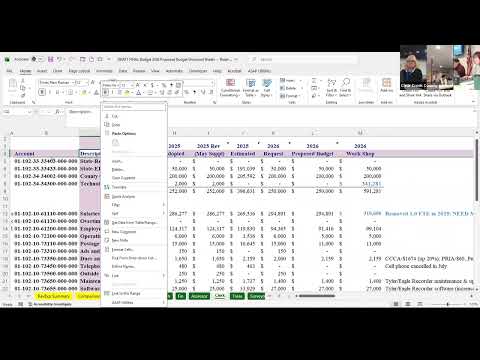
The meeting opened at 11:06 with the board chair saying the session would begin with "a big picture summary from our finance director," who told commissioners the proposed budget shows expenses materially above projected revenues and that, without reductions, the county would face a several‑million‑dollar shortfall. The finance director said staff had reduced some requests, adjusted administrative charges in human services and the ambulance fund, and incorporated anticipated ballot‑initiative receipts into the emergency services general improvement district (ESGID) calculations.
Why it matters: Commissioners must decide which one‑time and recurring items to fund in a tight revenue environment. Staff presented a data‑driven prioritization tool that averages commissioners' scores to group proposals into funding tranches and flags lower‑priority items for a possible June reassessment if revenue outperforms current projections.
Key decisions and proposals: The budget team proposed dividing requests into at least two tranches. The first tranche (highest priority) includes ongoing operations and several staffing restorations and preserves grant‑dependent items such as a transit vehicle purchase; the second tranche contains items to reassess in six months, including some positions, equipment upgrades, and capital projects. Colton, a staff member who summarized the prioritization matrix, explained the scoring: a lower average score indicates higher priority and funding earlier in the year.
Staff also spelled out mechanics for handling capital proceeds. They proposed putting building‑sale proceeds into the county CIP fund and using that one‑time revenue for capital needs rather than relying on ongoing operating funds.
Department issues raised: Several department‑level matters drew extended discussion.
- Clerk and Recorder: Brenda Corbett, introduced on the record as the county clerk and recorder, asked for a mid‑year staffing improvement to help with election workload and raised succession concerns because she expects to leave the county. She said the office needs someone trained to handle complex election tasks and suggested hiring help earlier in the year so a successor can be ready. Commissioners debated creating a temporary six‑month chief‑deputy position to provide training and continuity; some worried a new permanent FTE would be difficult to remove later, while others said short‑term help could protect election integrity.
- Emergency services / ESGID and ambulance fund: Staff reported that after contractual distributions and fees, ESGID receipts reflected in the packet left about $1.58 million for the county (transcript figure) while the ambulance fund's projected end‑of‑year balance improved enough that a general‑fund transfer would not be needed under current assumptions. Commissioners asked staff to follow up with the treasurer on interest‑earnings projections and on how treasurer fees may be applied to collections versus taxes.
- Housing authority: Staff explained the county operates a component unit housing authority distinct from the regional housing authority. A local planning grant was placed in the county's general fund rather than the authority, reducing the authority's expense and revenue lines; the county plans to transfer obligations to the regional housing authority when it is ready.
- Coroner and staffing comparables: Staff noted a staffing analysis that showed the coroner's office had higher FTE counts versus some peer counties. Commissioners and observers warned that peer comparisons are imperfect for rural or resort counties because visitor population and call volume alter workload; staff said they would continue to refine the comparables and the staffing analysis.
Next steps: Staff will refine revenue and expenditure estimates (including interest earnings), circulate the prioritization matrix and supporting materials to commissioners, and return with a final budget and a six‑month check‑in plan for tranche‑two items. No formal votes were recorded at the session; commissioners signaled broad support for using tranches and for revisiting contested staffing items in June.
Representative quotes: "This is a special meeting of the Board of County Commissioners. We're continuing our budget work sessions," the chair said at the outset. The finance director told the board that accepting all requests would leave the county "about $3.5 million over" (transcript figure approximated in discussion), and Clerk and Recorder Brenda Corbett warned, "I'm not going to be staying in the county," underlining the need for succession planning.
What to watch: Review of the treasurer's interest‑earnings assumptions, the treasurer fee interpretation, the outcome of the six‑month reassessment in June, and whether the board authorizes any temporary or permanent FTEs before the final 2026 budget is adopted.