Get Full Government Meeting Transcripts, Videos, & Alerts Forever!
Get email alerts on the Education Mtss topic
No spam. Unsubscribe anytime.
Darien schools lay out three‑year MTSS plan, seek unified data platform to track student progress
Summary
Darien Board of Education heard a multi‑tiered system of supports (MTSS) presentation outlining a three‑year phased implementation, an MTSS handbook in development, and plans to evaluate and adopt a unified data platform to support whole‑child progress monitoring and intervention planning.
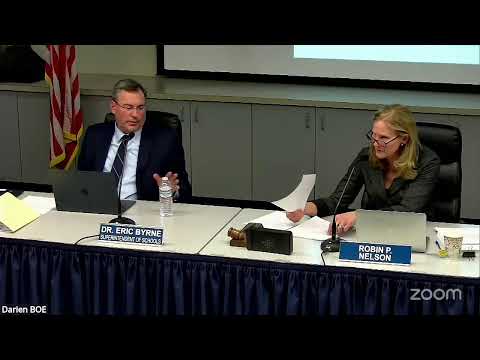
Darien — District staff presented a multi‑tiered system of supports (MTSS) plan at the Board of Education meeting on Dec. 9, describing a three‑year roll‑out intended to align instruction, assessment and professional learning across preschool through grade 12.
Superintendent Dr. Byrne and MTSS presenters characterized the change as a shift to a “whole‑child” approach to instruction and interventions. Presenters said the work emphasizes a stronger core, clearer tier‑1 expectations for every classroom, and timely, data‑driven interventions for students who need additional support.
The district team described the implementation as phased: phase 1 established a district leadership team and a draft MTSS handbook; phase 2 (current year) focuses on selecting a comprehensive data platform and refining protocols; phase 3 (2026–27 school year) aims to operationalize the handbook districtwide. Staff said the goal of a unified data platform is to assemble a “whole‑child portfolio” that combines academic, behavioral and social indicators so teams can monitor progress and make timely decisions.
Jennifer Falcone (director of elementary education), Roni Rodier (6–12 mathematics department chair), Kristen Colonies (literacy department chair) and Dr. Scott McCarthy (assessment lead) were introduced as key implementation leads. Presenters emphasized that the MTSS handbook will define entrance and exit criteria for tiers, standardize documentation and clarify roles so progress carries year to year.
Board members pressed staff on several operational points during a sustained Q&A. Katie (board member) asked whether inconsistencies identified in the self‑assessment were concentrated by teacher, content area or school; presenters replied those inconsistencies were typical across systems and are being addressed through clearer protocols and professional learning. Staff said Aspen will remain the family portal for grades and schedules but is not sufficiently granular for instructional decision‑making; the district is evaluating platforms that would support more detailed progress monitoring.
Questions about applying MTSS at the high school level — where students have multiple teachers and complex schedules — prompted presenters to point to existing supports: academic learning centers, writing and math labs, co‑taught classes and student assistance/intervention teams. Presenters said high school implementation will rely on teams and tailored workflows rather than a single classroom model.
Board members also asked about teacher capacity and initiative overload. Staff said the district plans to use existing PLC (professional learning community) time, expand coaching and extend work such as the OG Academy to more general education teachers rather than creating entirely new training blocks.
No formal action was taken on MTSS at the meeting. Staff said they will return with updates, an MTSS handbook draft and any FY28 budget implications tied to staffing, professional learning and platform costs.
What happens next: the district will continue stakeholder review of data platforms during phase 2, refine the MTSS handbook and present budget recommendations and draft protocols in upcoming curriculum committee and board meetings.