
St. Mary’s County Public Schools presents $307.1M FY2027 recommended budget, explains 18-digit account coding
Summary
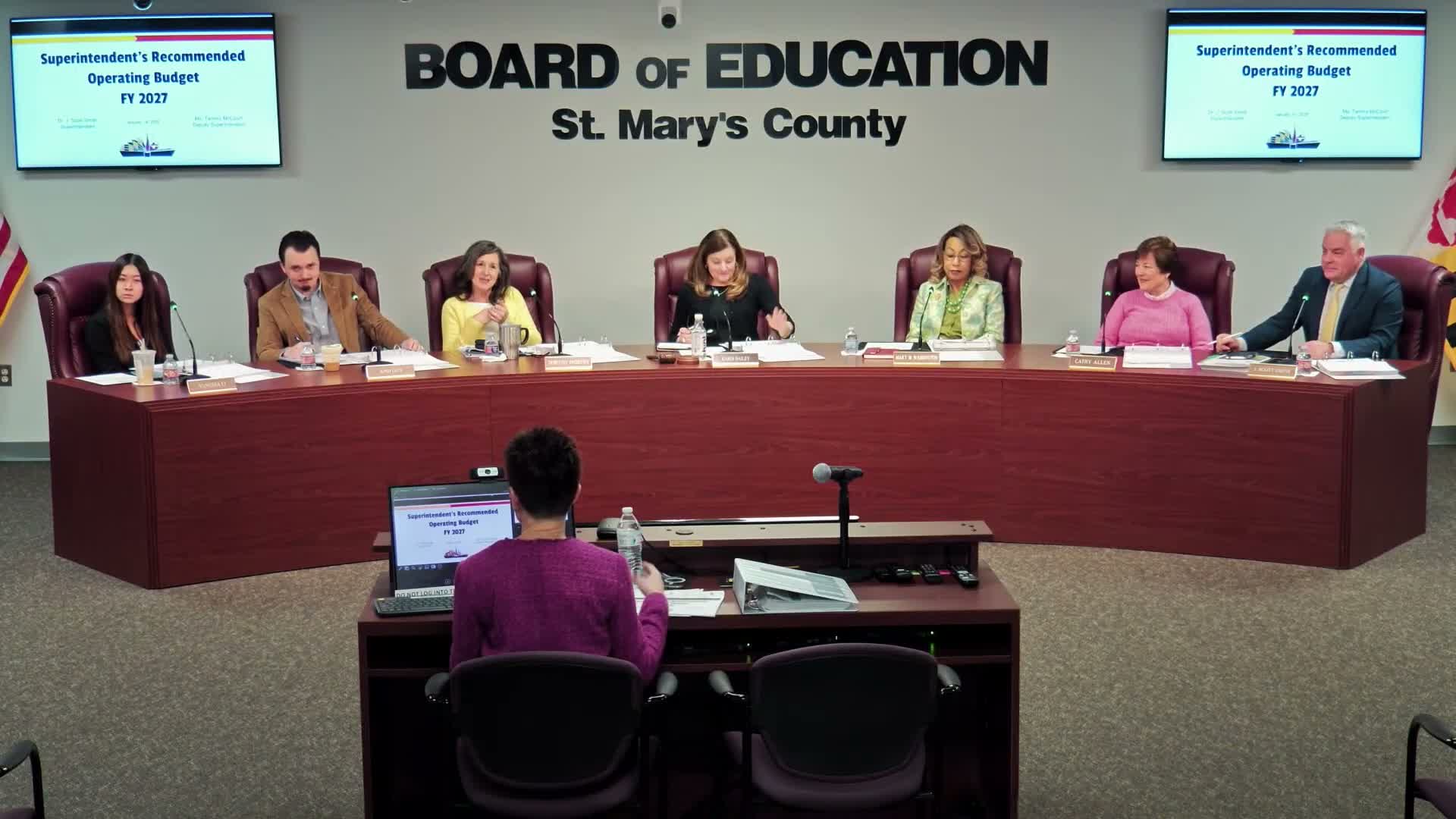
Superintendent staff presented a $307.1 million FY2027 recommended operating budget and walked board members through the district's 18‑digit account coding; key changes include $8.5M for negotiated steps and COLA, shifts in staffing, transport and special-education increases, and a public hearing next week.
St. Mary’s County Public Schools staff presented the superintendent’s FY2027 recommended operating budget at a Jan. 14 work session and explained the district’s 18‑digit account coding system used to report spending to the Maryland State Department of Education (MSDE). "So decoding the 18 digit account number system," presenter Tammy said, describing fund, category, program, location, project and account fields that roll up to MSDE reporting.
The recommendation calls for a $307,100,000 total request, a $9,000,000 (3%) increase over the prior year. Staff said the district is asking county government for a $9,500,000 increase (6.9% local request) and estimates state aid at $148,200,000 (an increase of $1.6 million). "The total request is $307,100,000," Tammy said during the presentation.
Major components: the district identified $8.5 million tied to negotiated compensation increases: steps totaling $4,700,000, a 2% cost‑of‑living adjustment for three bargaining units totaling $3,500,000, and a $300,000 increase for national board‑certified teachers. Instructional salaries remain the largest category with a $107.2 million request (+$3.4 million, 3.3%). Special education is budgeted at $27.6 million (+$1.6 million); transportation is budgeted at $26.7 million (+$1.0 million); fixed charges (pensions, health insurance and related costs) total $72.6 million (+$2.0 million).
Staff described several staffing and program changes: three athletic trainers will be added while positions tied to enrollment declines (6.5 teachers and 4 paraeducators) were reduced or reallocated; three full‑time equivalent athletic trainer roles replace contracted trainers; one nurse previously funded by a grant was moved into the operating budget. Operations staff said two positions will be removed (a facilities compliance analyst and a print‑shop lease) to realize savings; the system will contract out print needs as required and add a cybersecurity project coordinator to bolster digital protections.
On account coding, Tammy explained the first two digits identify the fund (for example, Fund 10 = unrestricted; Fund 50 = food services), two digits show the MSDE/COMAR category, three digits indicate program, four digits are location (school or department), three digits are project (grants/CIP/blueprint funds) and the last four digits are the account and object detail. The system, staff said, produces many thousands of reporting lines monthly to MSDE to provide transactional transparency.
Budgeted programmatic changes tied to Maryland’s Blueprint categories include a $1.0 million increase in foundation funding, a $997,000 increase for full‑day pre‑K per‑pupil allocation, a $1.4 million increase in special education funding, and a $487,000 reduction tied to one transition grant being removed. Staff noted the final state allocations may change after the governor’s budget release and MSDE’s subsequent estimates.
Transportation details: staff budgeted fuel at $3.75 per gallon for contractor payments and described a monthly averaging process using three pump surveys; a transportation reserve in fund balance (stated as $500,500) was cited to cover contingencies. For facilities utilities, staff said Piney Point’s new propane system required vendor and engineering estimates and a temporary 25% consumption factor until multi‑year predictive modeling is available.
A board member raised statewide funding shortfalls for special education and transportation; during back‑and‑forth on the floor one member cited $1.5 billion while staff corrected a memory figure to $1.1 billion for special education, noting combined gaps with transportation in the same discussion. The exchange was captured and left unresolved in the meeting record pending further advocacy and legislative action.
Next steps: staff said the board will take the recommended budget to a public hearing next Wednesday evening; the governor is scheduled to release his budget Jan. 21 and MSDE estimates will follow. The work session concluded with board members praising fiscal services for detailed documentation and independent audit results.
The work session produced no formal vote; the board will receive public comment at the scheduled hearing and may adjust the request based on county and state actions.

Create a free account
Unlock AI insights & topic search