Get AI Briefings, Transcripts & Alerts on Local & National Government Meetings — Forever.
Baltimore County police say electronic court filing has sped protective‑order processing
Loading...
Summary
Baltimore County Police described a mid‑October rollout of the Maryland Electronic Court Document system (MDEC) for protective orders, reporting about 1,500 orders routed through the system and changes intended to reduce transit delays and create an auditable record of service.
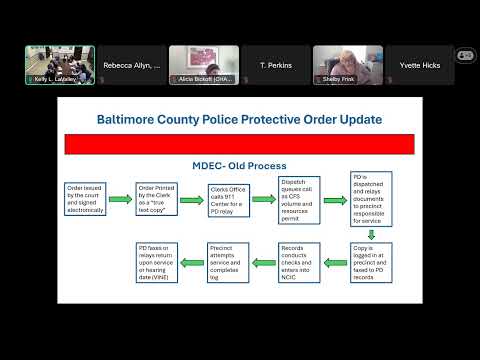
Baltimore County police officials told a BCStat work group that switching to the Maryland Electronic Court Document (MDEC) system in mid‑October has significantly shortened the time between courts issuing protective orders and officers attempting service.
Major Wes Fisher of the Baltimore County Police Department said the prior process required clerks to print orders and call 911 so officers could pick them up and hand‑carry copies around the county, which created batching delays and long hold times at the communications center. "When that order is issued by the court, they are able to assign a Baltimore County Police Department as a party to that case, and that order is immediately sent to our records section to an account that's monitored 24/7," Fisher said, describing the new workflow. Records now enter orders into NCIC and run background checks before the order is routed electronically to the serving precinct.
Roberts, the BCStat facilitator, and several providers pressed the police on data capture and accountability under the new system. Fisher said the department added a central‑records staffer to follow up on misrouted messages and that desk officers at precincts received most of the initial training. He reported that roughly "1,500 orders have come through the system" and that only a few early errors required intervention.
Commanders also described operational changes aimed at increasing attempts to serve orders. Fisher said some precincts are dedicating officers whose sole tour focus is serving protective orders, a new internal policy intended to raise attempted‑service counts and improve documentation of failed attempts.
The department noted precinct variation in service volumes; Precinct 6 showed higher activity, Fisher said, in part because of cooperation with the Baltimore County Detention Center to serve multiple incarcerated respondents at once. Fisher added that when orders are marked served, officers upload a scanned copy to the case file so the domestic violence clerk's office and the public victim portal (VINE) update in near real time.
Roberts and others asked for richer electronic logging at the precinct level—including a count of attempts and reasons an order could not be served—to distinguish avoidable delays from cases where respondents could not be located. Fisher said the department is exploring electronic logs while keeping hard‑copy records for auditability.
The work group requested that the police post the presentation slides and provide follow‑up data on attempts and service outcomes at a future meeting. The department indicated it could produce additional reports derived from the new MDEC workflow and follow up on training penetration across precincts.