Evanston technical committee reviews building performance standards, sets homework on renewables and interim targets
Loading...
Summary
The Healthy Buildings Technical Committee reviewed key provisions of Evanston's building performance standards ordinance — including EUI, net-zero on-site emissions and 100% renewable electricity goals — and agreed to develop a syllabus and staff materials on renewable pathways and interim standards ahead of rulemaking.
The Healthy Buildings Technical Committee for the City of Evanston spent its Jan. 7 meeting walking through highlighted sections of a new building performance standards ordinance and laying out next steps for rulemaking and community outreach. Speaker 2, who led the ordinance review, read a central provision: "Each covered property in the city of Evanston must, by 2050, meet and maintain the following final performance standards." The ordinance lists three pillars: energy efficiency measured by a maximum normalized site energy-use-intensity (EUI); zero normalized on-site district greenhouse gas emissions; and 100% electricity supplied by renewable sources.
Committee members pressed staff on how terms will be defined in the rules package. Several members asked for clarity on "maximum normalized" EUI and how interim standards will be calculated. Staff emphasized that the ordinance sets the high-level goals while a companion rules packet will spell out reporting requirements, the timeline for interim targets and enforcement steps. The city reiterated that the first required reporting will be for 2030 data, due June 30, 2031, meaning compliance assessments and any performance-based penalties would follow that reporting cycle.
The committee agreed to organize its work around a short syllabus of priority topics — renewables, alternative compliance pathways (ACPPs), net-zero definitions and interim performance standards — so each meeting can produce focused recommendations for the Healthy Buildings Accountability Board. Speaker 1 said staff will prepare deeper material on renewable-electricity pathways (on-site solar, community solar subscriptions, procurement agreements and treatment of renewable energy certificates) and survey examples from other jurisdictions for the next meeting. Members also asked staff to clarify how multifamily participation in community choice or subscription models will be counted toward the 100% renewable goal.
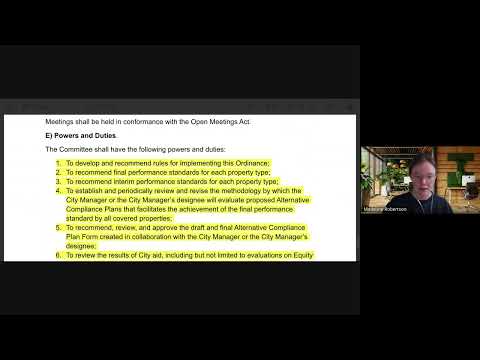
On the committee’s role, the ordinance tasks the Technical Committee with developing rules and procedures, recommending final and interim performance standards for each property type, defining methodology for evaluating ACPPs and advising on outreach and equity priorities. The group emphasized a phased, assistance-first approach to compliance, noting that enforcement experiences in other cities (including later adjustments to targets after public pushback) counsel patience and robust stakeholder engagement.
Next steps: staff will circulate a draft topical syllabus and a packet of comparative examples in advance of the next meeting; ComEd has been invited to give a short presentation at the following meeting if scheduling permits. The committee is expected to refine interim targets and draft rule text during upcoming sessions.