Get Full Government Meeting Transcripts, Videos, & Alerts Forever!
Get email alerts on the 2737 Highland topic
No spam. Unsubscribe anytime.
Evanston land use panel denies front‑driveway variance for Highland Avenue home
Summary
The Land Use Commission unanimously denied a request to allow a front‑yard driveway and parking at 2737 Highland Ave, finding the code’s intent and pedestrian‑safety concerns outweighed the applicant’s ADA accommodation claim. The applicant is advised to work with staff on rear‑yard alternatives.
The Evanston Land Use Commission voted 0–8 on Jan. 14 to deny major variations requested for 2737 Highland Avenue that would allow a concrete driveway and an open parking space in the front yard despite alley access.
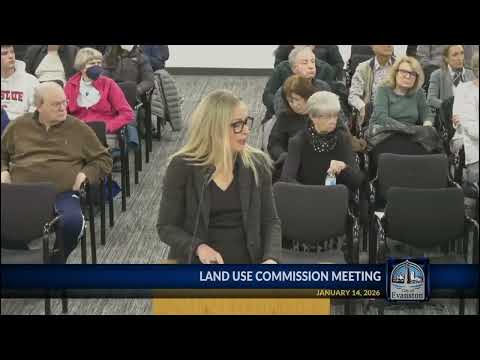
Attorney Katarina Carrick, representing owners Laleh and Ali Hermedan, asked the commission to treat the request as a reasonable accommodation under the Americans with Disabilities Act. Carrick said Ali Hermedan is wheelchair‑bound after recent medical events and that rear‑yard access requires negotiating multiple stair sets and a long walk across uneven, often icy ground. "This request is essentially a reasonable accommodation," Carrick said, describing the family as multigenerational and the driveway as necessary for safe, independent access.
Chair Linwall led commissioners through the ordinance standards and repeatedly concluded several were not met. Citing pedestrian‑safety issues, proximity to a fire hydrant and parkway tree, and the fact the front parking pad was installed without a permit, Linwall said, "I do not believe that standard is met," on multiple required findings. Commissioners also found the hardship was, at least in part, self‑created because the work continued after a stop‑work order and an earlier permit denial.
Commissioners asked staff and the applicant a series of questions about the permit history: a permit application was submitted and denied in November 2024, a stop‑work order followed in June 2025, and the property owner said work was completed afterward because the contractor left the site in a partially excavated condition. Staff noted the city could explore minor rear‑yard adjustments as a less‑deviating alternative and recommended the applicant work with staff on solutions that avoid new curb cuts on Highland.
With the formal denial, the commission advised the applicants to pursue rear‑yard or other staff‑reviewed options that might provide accessible access without creating a new street curb cut. The commission closed its consideration of the case after the vote.