Get Full Government Meeting Transcripts, Videos, & Alerts Forever!
Get email alerts on the Arts And Culture topic
No spam. Unsubscribe anytime.
Commission recommends Miriam Bravo as Green Bay Poet Laureate after debate over AI use
Summary
The commission voted to recommend Miriam Bravo as Green Bay’s 2026–2028 Poet Laureate after reviewing 14 RFQ submissions and five finalists. Commissioners discussed language to limit AI-generated original poetry and agreed staff would draft contract guardrails before city council consideration on Jan. 20.
The commission voted to recommend Miriam Bravo as Green Bay’s Poet Laureate for the 2026–2028 term, endorsing a staff recommendation after reviewing an evaluation of 14 RFQ submissions and five finalists.
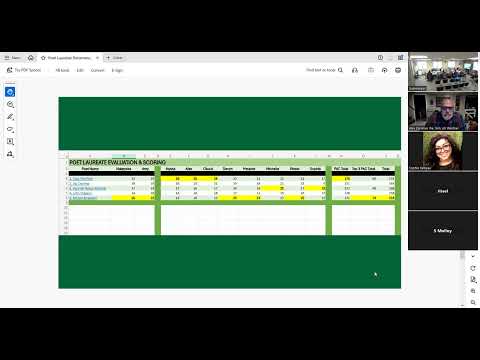
Staff member Eric opened the discussion and read a poem by former U.S. Poet Laureate Joy Harjo before outlining the selection process. Eric said an outside jury and the commission scored proposals across five rubric categories and that Miriam led the overall tally with 219 points. "I would like to read a poem by Joy Harjo," Eric said during his remarks; later he told commissioners the finalists had already been informed of the recommendation.
Why it matters: The appointment will be forwarded to the Green Bay common council for final approval, and the role is intended to raise the city’s profile for literary arts and public engagement. Commissioners emphasized both the symbolic value of the laureateship and the need for clear expectations about the laureate’s creative work.
Debate over AI use: Several commissioners pressed staff on whether the selection agreement should address use of artificial intelligence. Commissioner Sophie Bebo said the application did not directly address AI and that the commission should consider the issue. "We should ask a stance on AI," she said, calling for clarity on whether AI-generated work would be allowed. Eric provided a staff view that the city could insert contract language and "put some guardrails up," saying the agreement could specify that original poetry "shall not be created using AI tools." Eric also said staff could consult with peer jurisdictions and, if necessary, use detection tools.
Commissioners expressed differing views: some urged a hard line against AI in the poet’s creative work; others suggested limited use of AI as a promotional or organizational tool (for example, social-media copy) might be acceptable with clear boundaries. The commission did not adopt language at the meeting but asked staff to draft recommended contract language addressing original-work restrictions and promotional practices.
Formal action and next steps: A motion to recommend Miriam Bravo was made, seconded and approved by voice vote; the transcript records multiple "Aye" responses and the chair declared the motion approved. The commission’s recommendation will go to the common council, which Eric said was scheduled to consider it on Jan. 20; staff advised awaiting council action before releasing publicity about the appointment.
Additional details: Eric said the finalists will be invited to a public celebration and reading on Jan. 29 hosted with a local bookstore and noted an invitation for the incoming laureate to participate in a Milwaukee poetry marathon at Saint Kate’s hotel. Commissioners also discussed using remaining ARPA and other grant funds in forthcoming program restructuring, which Eric plans to present at the commission’s next meeting.
The commission adjourned after scheduling the next meeting and confirming staff follow-up on contract language, finalist outreach and the council submittal.