Get Full Government Meeting Transcripts, Videos, & Alerts Forever!
Get email alerts on the Prior Authorization Reform topic
No spam. Unsubscribe anytime.
Massachusetts to remove many prior authorizations, create affordability working group to speed care
Summary
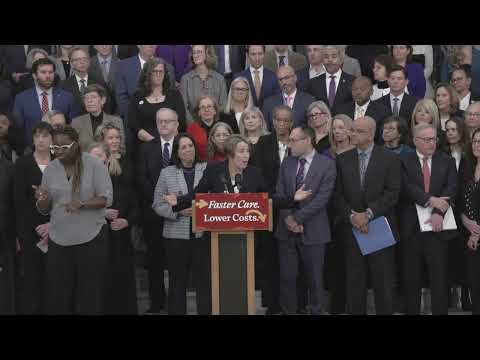
Governor Healy announced state regulations to eliminate prior authorization for a broad set of routine treatments and equipment, require 24-hour responses for urgent requests, and convene a cross‑sector health care affordability working group co‑chaired by Kate Walsh and Lisa Murray.
Governor Healy announced new state regulations aimed at reducing delays in care by eliminating prior authorization requirements for a broad set of routinely approved treatments and equipment and by convening a health care affordability working group to recommend further reforms.
The regulations, filed this week, will remove prior-authorization requirements for “a wide range of medical drugs, services, and equipment,” the governor said, listing primary care, emergency care, chronic disease management, vaccines, reproductive and maternity care, physical therapy and substance-use services among the categories affected. “We're getting rid of prior authorization for a whole bunch of situations,” she said.
The administration also said plans must respond to urgent prior-authorization requests within 24 hours and that a beneficiary’s new plan must honor an existing authorization to avoid interruptions in care. Officials said insurers will be required to publish their prior-authorization practices to reduce uncertainty for patients.
Insurance Commissioner Mike Caljo, who helped lead the Division of Insurance review, said state stakeholders have worked with hospitals, health plans and consumer advocates to standardize and streamline prior-authorization requirements. "We really have done a lot to take action to reduce administrative waste, improve access to health care, [and] streamline and standardize prior-authorization requirements," Caljo said.
The administration said the rules will align in part with language in the federal PACT Act for categories of chronic treatments, but that the state does not yet have a complete catalog of specific drugs that will be affected. Officials said the regulations will be filed this week and that the new rules should begin to take effect as plans complete needed operational changes.
As part of the announcement, Governor Healy established a health care affordability working group co‑chaired by former health secretary Kate Walsh and Lisa Murray, the Massachusetts state president at Citizens. Secretary of Health and Human Services Kiyami Mahania said the group will focus on four central questions: ensuring patients receive care in the right setting at the right time; identifying innovative payment methods; reducing waste and inefficiency; and enabling clinicians to work at the top of their licenses using technology.
A patient who identified herself as Melissa described months-long delays in obtaining an expensive immunotherapy drug and said the wait led to hospitalization and some permanent damage. "In the world of neurology, an illness like mine, 3 months is like 3 years," Melissa said, urging faster approvals.
Governor Healy said she expects the working group to move quickly and indicated she would like to see some concrete recommendations by June. She also criticized federal cuts to health-care funding that, in her remarks, she said have worsened affordability pressures.
Officials did not present a formal vote or statute at the event; rather, they described a regulatory process and an advisory working group. The state said it will continue to update stakeholders and the public as regulations are finalized and implementation proceeds.