
District projects continued growth; task force recommends new Otsego high school as primary solution
Get AI-powered insights, summaries, and transcripts
Subscribe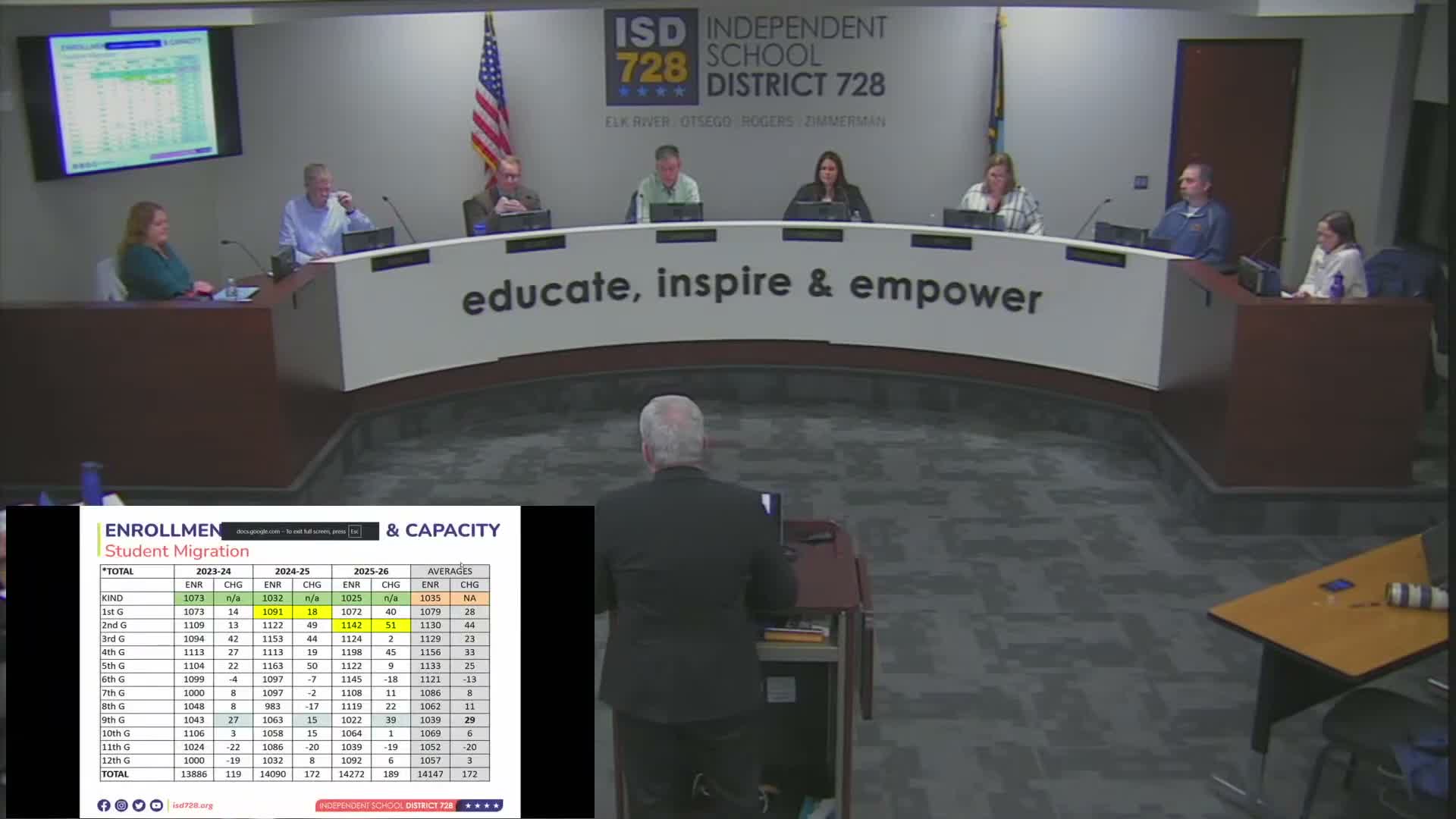
Summary
Dr. Joel Stangler reported Jan. 1 enrollment of 14,420 (up 192), projected +158 next year; a community facilities task force recommended building a new Otsego 9–12 high school as the top option to address southern-end capacity, with alternatives including a new elementary and additions.
At the Jan. 12 meeting, Dr. Joel Stangler, director of student services, research and planning, presented the district’s Jan. 1 enrollment point-in-time total: 14,420 K–12 students, an increase of 192 students (about 1.3%) from the previous year. Dr. Stangler said most of the enrollment increase was at the secondary level and that projections for the coming year estimate an additional 158 students.
Stangler explained drivers behind growth and decline across regions: the South (Otsego and Rogers) has seen the strongest increases, while the center and north (Elk River and Zimmerman) saw declines or stabilization. He described kindergarten replacement, cohort migration, and unique local factors (for example, Spectrum adding a fifth grade that shifted 38 students away from the district) as influences on projections. He cautioned that district-wide capacity could be strained in three to four years depending on growth and distribution.
Director Fransen and Dr. Stangler summarized the findings of a community facilities task force that met from September through December. The task force — which included approximately 40 community members and gathered roughly 1,500 survey responses — produced two primary recommendations: the top recommendation is to build a new Otsego 9–12 high school to address high-school capacity and then address middle- and elementary-level needs through additions or new construction. An alternative recommendation was to build a new elementary school in the south, expand Rogers High School to relieve high-school capacity, and consider shifting grades (for example, moving fifth grade into elementary) as a configuration solution.
The task force also issued statements of consultation recommending the district continue to investigate potential land acquisitions, preserve class-size considerations in planning, and treat boundary changes as a last resort or temporary measure.
Board members asked clarifying questions about the survey sample and projections; Dr. Stangler said the survey’s response volume produced a margin of error of about ±3 percentage points at the 95% confidence level and that the district used multiple modeling approaches to arrive at conservative projections. The board scheduled more detailed facilities discussions at upcoming work sessions.