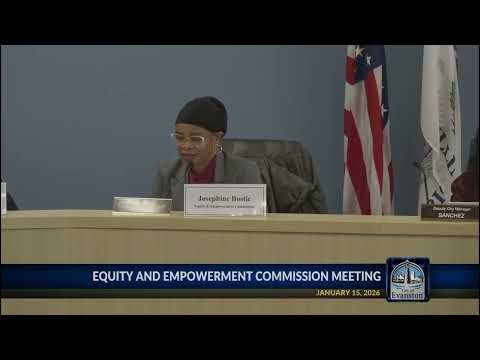
Evanston Equity and Empowerment Commission opens 2026 with 'reset' plan, eyes housing and waste transfer station
Loading...
Summary
At its Jan. 15 meeting the Evanston Equity and Empowerment Commission proposed a “reset” to focus on two priorities at a time — with housing affordability and the long‑standing waste transfer station cited as candidates — planned outreach for an equity scorecard survey, and discussed recruitment for three vacancies.
The Evanston Equity and Empowerment Commission opened its first meeting of 2026 on Jan. 15, calling for a yearlong “reset” that would concentrate the body’s work on no more than two priorities at a time and use an equity scorecard to evaluate proposed actions. The commission convened at 6:08 p.m. and adjourned at 7:21 p.m.
The chair framed the reset as a way to rebuild focus and accountability after a period of low engagement and vacancies, and proposed using 60–120 day work cycles to develop recommendations that the commission could present to the City Council. The chair said the equity scorecard should clarify “who benefits, who is burdened, what mitigation is required and what measurable outcomes are expected.” (chair remarks paraphrased from meeting discussion.)
Commissioners discussed several candidates for the two-priority model. The waste transfer station — described during the meeting as a decades‑old neighborhood burden — and housing affordability were raised repeatedly. Council member Harris urged the body to narrow the list before the next meeting and to bring brief, skeletal plans so the commission can choose two priorities and assign leads: “I think by the next meeting, we need to really all decide,” Harris said, asking members to return with at least a rough outline of what they would pursue.
Commissioner Akila Jones and others emphasized that most of the work must happen between monthly meetings, and recommended defining roles for leads and shared accountability. The chair proposed an internal transparency dashboard and regular 30‑day progress updates so the commission can track deliverables without making the tool punitive.
The commission also addressed outreach for its equity scorecard survey after staff said prior online responses were low. Commissioners agreed to present the survey at ward meetings, use QR codes and tablets where possible, and provide paper copies for patrons without devices; a modest raffle incentive was on the table to boost participation. Deputy City Manager Sanchez confirmed there were three applications to fill the commission’s vacancies in 2025 and said she would provide applicant information to the chair for follow up.
A public‑safety concern raised by a commissioner focused on interactions between ETHS security officers and students; Amari Ratcliffe said students report feeling disrespected and unsafe. Council member Harris noted that school‑personnel issues are typically handled by the district and offered to follow up with district officials to ensure concerns are routed to the appropriate authority.
On administrative items, the commission approved the Dec. 18, 2025 meeting minutes and discussed — but postponed — a vote on retaining the chair for another term to allow all commissioners time to consider nominations. Deputy City Manager Sanchez reviewed the commission tracker and flagged upcoming council referrals including a proposed ordinance to prohibit smoking in parks that contain children’s equipment, scooter regulations and a referral on tax‑increment financing (TIFs); staff identified no immediate deadlines requiring action by the commission before its next meeting.
The commission closed by reiterating the chair’s request that commissioners select and flesh out two priorities in the coming weeks. The meeting was adjourned at 7:21 p.m.