Jackson board agrees to explore Washington County EMS levy option
Loading...
Summary
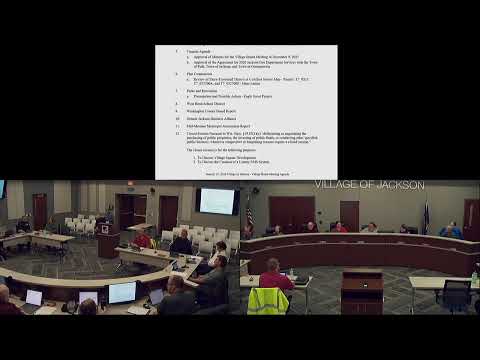
Trustees on Jan. 13 directed staff to prepare a resolution to pursue participation in a proposed Washington County EMS levy option after hearing a staff presentation on staffing, levy limits and governance implications.
President Heckendorf said the Village of Jackson will continue conversations with Washington County about a county‑level fire and EMS levy after trustees voted Jan. 13 to direct staff to draft a resolution acknowledging the village’s participation in the effort.
Village Administrator presented slides and a summary memo explaining that the county has a statutory tool—available only to counties in Wisconsin—to levy for fire and EMS that could move some taxing authority from municipalities to Washington County. Administrator said the presentation’s purpose was to give trustees enough information to decide whether staff should continue negotiations and background work; it was explicitly described as an exploratory, two‑night conversation rather than a binding commitment.
The presentation said Jackson’s department is a combination model that has recently added full‑time staffing while paid‑on‑call availability has declined. Chief Swaney told trustees the department is “bringing a lot of people in, but they’re not staying,” citing departures after testing, fit or time‑commitment issues. Administrator and Chief Swaney said the county option would not dissolve departments or remove local identity—“we remain Jackson on the side of our ambulances and engines,” the administrator said—and that mutual‑aid arrangements would continue to operate.
Staff framed the county levy option as a way to address long‑term pressures. Administrator noted levy‑limit mechanics and net new construction numbers (the presentation referenced the county average at about 1.7% and Jackson’s recent net new construction above 4%), and cautioned that relying on local referendums later could be risky. Trustees questioned how budgets and personnel requests would be approved under a county system, whether Jackson would retain meaningful local control and how cost‑allocation formulas would treat EMS versus fire costs.
Chief Swaney and staff acknowledged that while Jackson’s calls are heavily EMS‑weighted, EMS operations typically cost less than fire operations, so any county formula would need to separate EMS and fire expenses and account for EMS billing revenue. Trustees also raised concerns that participating communities might see tax shifts—some Jackson taxpayers could pay less while others pay more—because county levying would spread costs across a larger base.
After questions and discussion, President Heckendorf moved and Trustee Kurtz seconded a motion directing staff to prepare a resolution acknowledging the village’s participation in pursuing a county EMS system. The motion carried on a voice vote. Administrator told the board that moving forward would create a working group and, later, an intergovernmental agreement if enough communities are interested.
The board’s action was advisory and exploratory: multiple trustees emphasized that continuing conversations did not commit Jackson to any future transfer of taxing authority or to signing any agreement, and that the village could stop the process at any time if details proved unfavorable.