Get Full Government Meeting Transcripts, Videos, & Alerts Forever!
Get email alerts on the Infrastructure topic
No spam. Unsubscribe anytime.
Arvada infrastructure leaders outline 2024 accomplishments and 2026 priorities, including smart meters and 75-lane resurfacing goal
Summary
City infrastructure leaders briefed council on Dec. 9 about 2024 accomplishments — advanced meter installations, lead service‑line replacements, fiber expansions and utility partnerships — and set 2026 priorities including completing AMI, rolling out e‑billing, and resurfacing 75 lane miles.
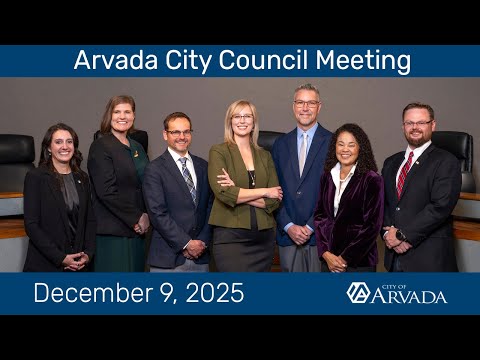
City infrastructure leaders presented the annual infrastructure report to the Arvada City Council on Dec. 9, summarizing accomplishments in water, utilities, streets and traffic operations and laying out key priorities for 2026.
"We believe excellent infrastructure is essential to our economic vitality as a city," Jacqueline Rhodes, the city's infrastructure director, told council as she introduced staff and the presentation. Dominic Vessa, deputy director of operations, highlighted two operational programs that drew council attention: the advanced meter infrastructure (AMI) rollout and lead service line replacements.
Key numbers and milestones: Vessa said Arvada has installed about 27,000 of the 40,000 smart meters the city has purchased, with an anticipated AMI program completion in 2027. He said the city has replaced 68 lead service lines so far and is verifying roughly 480 additional services; the leadership goal is to complete replacement work by 2026. Chris Gray described the city's water‑supply strategy, noting Arvada is a financial partner in Denver Water's Gross Reservoir expansion and is contracted to pay one‑sixth of construction costs to receive 3,000 acre‑feet of additional supply if Denver Water's litigation succeeds.
Customer service and technology: Gray said the city plans to enable e‑billing for all customers by Christmas and is working on autopay capability. The city also reported laying more than 16,000 feet of fiber this year, achieving 100% signal connectivity, and planning further fiber redundancy work along Alkire Street and 52nd Avenue.
Streets, signals and safety: Staff described signal retiming projects that will touch roughly 25% of the signal network, two signal installations completed this year and four planned for next year. The pavement program was highlighted as a top 2026 priority: the council and staff set a goal of resurfacing 75 lane miles in 2026, supported by additional funding. Rhodes noted the department completed various maintenance and concrete projects this year and that the pavement team is sequencing concrete and resurfacing work to reduce rework.
Sustainability and other items: Rhodes said the Arvada Aquatic Center has earned LEED Silver and an engineering award; the city anticipates 42 EV chargers when current projects finish (20 public chargers already online) and highlighted a $900,000 DRCOG Building Policy Collaborative award to support decarbonization staff positions and building electrification efforts.
Council follow-up requests: Council members asked for an AMI rollout map, clarification on how many lane miles were resurfaced versus treated in 2024 (staff said they would provide the treated vs. resurfaced breakdown), timing for the Climate and Sustainability Action Plan public comment results and a February workshop, details about signal and speed‑management software trials, and options for monetizing city fiber. Staff agreed to share rollout maps, maps of planned pavement work and follow‑up materials on waste‑diversion and ADA transition planning.
No formal policy action or votes were taken at the workshop; staff said they will return with follow‑up materials and maps.