Get Full Government Meeting Transcripts, Videos, & Alerts Forever!
Get email alerts on the Energy Storage topic
No spam. Unsubscribe anytime.
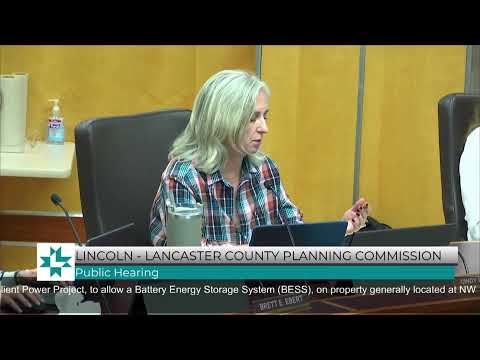
Lancaster County planning commission clears 200-MW Pawnee Lake battery project despite resident safety and decommissioning concerns
Summary
County planning commissioners approved Special Permit 25045 for a roughly 200-MW battery project on the county's west edge (NW 140th & Holdridge), 7–0, with conditions including Malcolm Fire and Rescue approval of the emergency action plan, screening, drainage easement and a decommissioning surety estimated in the applicant's plan.
The Lancaster County Planning Commission voted 7–0 on Jan. 7 to approve Special Permit 25045 for the Pawnee Lake Resilient Power Project, a battery energy storage facility proposed for the county’s west edge near Northwest 140th Street and West Holdridge Street.
Planning staff summarized the county-jurisdiction application as a roughly 20-acre site with approximately 16 acres devoted to battery enclosures and associated infrastructure. The project would interconnect to a nearby NPPD substation. County staff recommended several conditions including evergreen screening along Northwest 140th at a rate of six trees per 100 linear feet, a drainage easement centered on an on-site channel (120-foot buffer), health department review of required safety data sheets, and a decommissioning surety as a condition of approval. Staff also noted that Malcolm Fire and Rescue must approve the site-specific emergency action plan before building permit.
Applicant representatives said the Pawnee Lake project uses lithium iron phosphate containers in non-occupiable enclosures and listed project-scale visuals and benefits, including an applicant estimate of roughly $20 million in tax revenue over 20 years and about $4.5 million to the local school district. The applicant described 242 containers on the conceptual site plan. Project engineering and environmental permitting (including SWPPP/SWIP reviews) remain to be completed, the applicant said.
Multiple nearby residents testified in opposition. Julia Lostro and other neighbors who live immediately adjacent to the site said they were not swayed by developer assurances, raised questions about long-term operational accountability, potential water and soil impacts in the event of a fire, and the possibility of future expansion and eminent domain. Residents pressed for stronger lifecycle guarantees and more detail about monitoring, response times and who would pay for training and potential cleanup. Planning staff and the applicant described existing enforcement mechanisms tied to the special permit, building-code and state inspections (electrical inspector/state fire marshal at commissioning), and explained the county’s decommissioning process, citing an estimate in the applicant’s decommissioning plan of about $5,400,000 with a salvage value of about $2,700,000.
Commissioners discussed the project as a land-use decision (not a technical engineering approval) and cited conditions that remain to be satisfied prior to building permit. After discussion the commission moved to approve the special permit with the recommended conditions and the motion passed 7–0.
Next steps: the applicant will finalize technical permits (state electrical and fire inspections at commissioning), complete SWIP/SWPPP permitting, finalize drainage and landscape plans including the required drainage easement, and demonstrate Malcolm Fire and Rescue approval of the emergency action plan before building permit.