Get Full Government Meeting Transcripts, Videos, & Alerts Forever!
Get email alerts on the Energy Storage topic
No spam. Unsubscribe anytime.
Commission approves 170-MW Cornhusker battery storage near Waverly with conditions
Summary
The planning commission approved Special Permit 25046 for a 170-MW battery energy storage system near North 120th and Highway 6, subject to landscaping, an emergency action plan approved by Waverly Fire and Rescue before building permit, and a decommissioning surety; vote was 7–0.
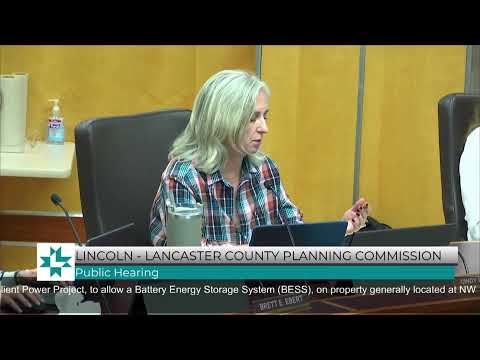
The Lancaster County Planning Commission voted 7–0 on Jan. 7 to approve Special Permit 25046, allowing the Cornhusker Resilient Power Project, a proposed 170-megawatt battery energy storage facility near North 120th Street and U.S. Highway 6.
George Wesselhoff of Planning and Development Services said the project sits in Lincoln’s three-mile extraterritorial jurisdiction and described a proposal that includes battery enclosures, monitoring equipment, access drives and a 25-foot-wide perimeter landscaping buffer added after early review. Wesselhoff said applicants submitted an emergency action plan; the plan and required safety data sheets were reviewed by the health department, and Waverly Fire and Rescue raised concerns about on-site emergency response capacity. Staff recommended a condition requiring the emergency action plan be approved by the applicable fire authority before building permit, and recommended a decommissioning surety based on the applicant’s decommissioning estimate.
David Levy, representing the applicant Sophos Power, described the project as large-scale grid-support infrastructure using lithium-iron-phosphate batteries in non-occupiable containerized enclosures. He and consultant Eric Wood (Energy Safety Response Group) outlined applicable standards, including NFPA 855 and UL 9540/9540A testing standards, and described 24/7 remote monitoring and site-specific emergency response planning. The applicant’s materials list 206 containers and a decommissioning plan with an estimated removal cost of more than $7,000,000; staff recommended the commission require a surety for decommissioning.
Waverly officials initially asked for additional screening around the eastern and southern borders; the applicant reported an agreement to screen the east side, the south side and the south half of the west side up to the access drive, and a letter withdrawing Waverly’s objection appeared in the project packet.
Residents at the hearing raised routine safety and operational questions about fire response, weather resilience and long-term maintenance. Eric Wood described testing and safety systems for modern containerized battery systems and said that, in an incident, the industry often allows a thermal event to burn out ("we allow it to self consume") after mitigation steps and remote shutdowns have been enacted. The commission included conditions requiring the emergency action plan approval by Waverly Fire and Rescue before building permit, specified screening and a decommissioning surety; the motion to approve passed 7–0.
Next steps: applicant must secure the stated emergency-action approvals, finalize landscaping details, provide the required surety language, and obtain building permits.