Get Full Government Meeting Transcripts, Videos, & Alerts Forever!
Get email alerts on the Property Taxes topic
No spam. Unsubscribe anytime.
Cape Coral staff warns dozens of Florida property‑tax proposals could cut local revenue by tens of millions
Summary
Assistant City Manager Mark Mason told Cape Coral council dozens of 2026 Florida proposals could reduce non‑school ad valorem revenue and sharply shrink funds for parks, transportation and administration; the city estimates a full elimination of non‑school property taxes would cost roughly $62.3 million locally.
Assistant City Manager Mark Mason told the Cape Coral Committee of the Whole on Jan. 14 that a broad set of bills and joint resolutions filed in the 2026 Florida Legislature could materially reduce the city’s property‑tax base and require the city to replace revenue or cut services.
Mason said the city’s 2026 tax roll shows 61,599 homesteaded properties — about 44.4% of parcels — representing roughly $12.6 billion of the city’s approximately $31 billion taxable value. “At the current millage rate of 5.1471, homesteader property tax revenue makes up $62,300,000 or 39.44% of the budgeted ad valorem revenue in fiscal year 2026,” Mason said.
He laid out several legislative scenarios, from modest changes to large exemptions. Mason identified House Joint Resolution 201 as the broadest measure, saying it “eliminates non‑school property taxes in their entirety,” which the city estimates would reduce Cape Coral’s ad valorem revenue by about $62.3 million. He described House Bill 203 as a phased $100,000 homestead exemption (about $25 million first‑year effect and roughly $62 million over five years in the city’s analysis) and noted HJR 209 — moving fastest in the House — would add a $200,000 homestead exemption for owners who carry property insurance (Mason estimated a first‑year local reduction of about $33.6 million, assuming no state replacement).
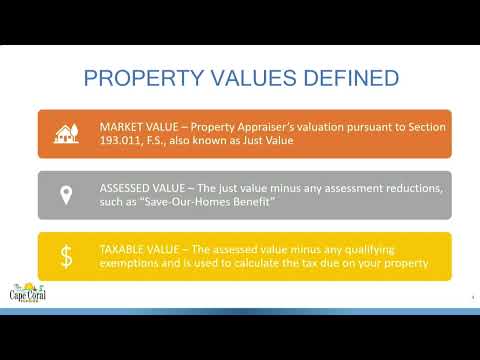
Mason emphasized implementation timing and legal mechanics: joint resolutions that become constitutional amendments would go to voters and, if approved, require subsequent implementing legislation; other bills need legislature approval and the governor’s signature and would generally take effect in the year after values are set. He also defined the terms policymakers use — market value, assessed value (pursuant to Fla. Stat. §193.011), and taxable value — so the council could understand how local levies would be affected.
The presentation mapped potential local mitigation options — increasing the fire‑service assessment to 100% of recoverable costs, raising millage, or (where law permits) pursuing additional local option sales taxes — and flagged limits: Mason said no state bills had yet been filed to replace local revenue lost under the proposals he reviewed.
Council members responded by pressing for early resident education and outreach so voters understand tradeoffs between tax relief and the local services taxes fund. Council member Steinke asked how the city should handle budget timing if an amendment takes effect early in a calendar year; Mason and staff clarified the assessed‑value determination date and the lag between valuation and tax collection meant fiscal impacts would be felt in FY2028 in most scenarios. Several members urged coordination with the Florida League of Cities to defend home rule and press for state revenue replacement.
Where the measures move quickly, Mason recommended continued monitoring and said staff have included homestead‑exemption contingencies in multi‑year forecasts for FY2027–29 so the city can present council with options once final legislative and ballot outcomes are known.