Get Full Government Meeting Transcripts, Videos, & Alerts Forever!
Get email alerts on the Ai Policy topic
No spam. Unsubscribe anytime.
Will County committee begins drafting countywide AI policy, members insist on human oversight
Summary
The Will County Capital Improvements Committee spent most of its Jan. meeting compiling priorities for a county AI policy: keep human oversight, inventory existing tools, require disclosures when AI is used and pilot closed-source systems with human review before adoption.
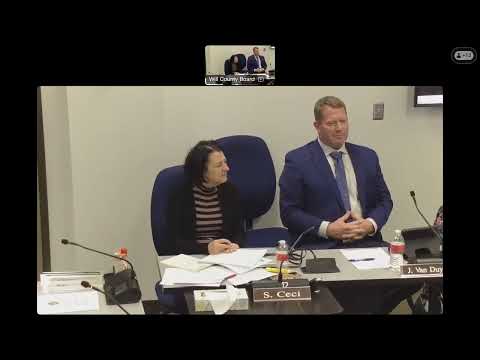
The Will County Capital Improvements Committee opened a multi-department conversation on a countywide artificial intelligence policy at its meeting that began at 10:04 a.m., focusing on safeguards for data privacy, human oversight and operational limits.
Chair opened the agenda item with documents from the Illinois State Association of Counties and asked the group to produce a short list of policy bullet points the committee can refine with IT at next month’s meeting. “Keep the Human Factor,” the Chair said, as a guiding principle the committee should include.
Several members pressed for concrete limits. Member Rabbit warned against replacing county employees with automation, saying it would be “dangerous when you have a robot taking the job of a human being,” and urged the policy to explicitly protect personnel roles while allowing AI to supplement staff work.
Data integrity and recordkeeping were recurring concerns. Mr. Balance said AI can republish inaccurate internet material and stressed that the county must preserve human-generated, permanent records: “We always have to have somebody doing real minutes … not AI.” The Chair added that several draft documents include a requirement to disclose when AI is used in producing material.
Staff described an ongoing pilot in Emergency Management (brought to the county’s attention by Allison Anderson) that uses a closed-source product to scan federal regulatory changes and flag county planning documents that may need updates. A county staff member said the pilot has run about six months and that “everything that we do has human eyes on it before it would ever get resubmitted as a planning document.”
The committee agreed on several next steps: commission a countywide survey of departments and independent elected offices to catalog what AI tools are in use, compile an inventory of programs and use-cases, and have Jason Donage from IT attend the next meeting to help draft operational parameters. Member Rabbit said the list he is compiling will include three buckets—operations (inventory/parameters/disclosure), HR protections (limits on replacing staff) and backup/archive strategies—and recommended piloting tools before countywide deployment.
Members also raised environmental and operational questions about data centers (including electricity and water use) and whether the policy needs language governing closed-loop or proprietary systems. Several members recommended reviewing model language from Montgomery County, McHenry County and NACO’s AI resources; Member Winfrey, who attended a NACO event, agreed to summarize NACO’s findings at the next meeting.
The committee did not vote on any policy at this session. It tasked staff to prepare the inventory and to invite IT and other stakeholders back next month to translate the committee’s bullet points into draft policy language.